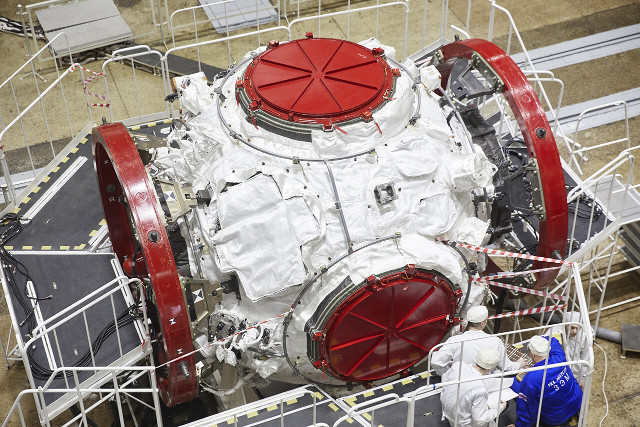
Yesterday, the Russian Prichal module, also known as Uzlovoy Module (UL), was launched atop a Soyuz 2.1b rocket from the Baikonur Cosmodrome, Kazakhstan. After a little more than nine minutes, it successfully separated from the rocket’s last stage and set off on its course. Its journey will take just over two days to reach the International Space Station, on November 26, where it will become part of the Russian section many years behind schedule. Prichal will be driven to its destination by a modified Progress cargo spacecraft.
The history of the Prichal module is part of the larger history of Russian projects for the International Space Station with many modifications and above all with many delays. In particular, the final choices were influenced by the ones regarding the Multipurpose Laboratory Module (MLM)/Nauka, the module that became part of the Station last July.
The Prichal module will be connected to the MLM, where the Progress MS-17 cargo spacecraft is now docked. The Russian space agency Roscosmos waited for the successful launch of Prichal to proceed with the Progress MS-17’s departure, scheduled for today with its disintegration re-entering the Earth’s atmosphere.
The Prichal module’s purpose is to add a number of hatches that allow the docking of other spacecraft but also of additional modules to the International Space Station’s Russian section. For this reason, it’s a relatively small module with its mass of almost 3,900 kilograms but important and comes at a time when there’s an air leak in the Zvezda module that makes it difficult to use it for docking.
The Prichal module is on its way to reach the International Space Station tomorrow, to dock at the MLM/Nauka module at about 15.26 UTC. In recent months, Russian space vehicles had some problems starting with the MLM/Nauka, whose thrusters got switched on after docking following a software problem moving the entire Station. In this case, the Progress space freighter that accompanies Prichal is the vehicle equipped with thrusters and we can hope they’ll work properly.