
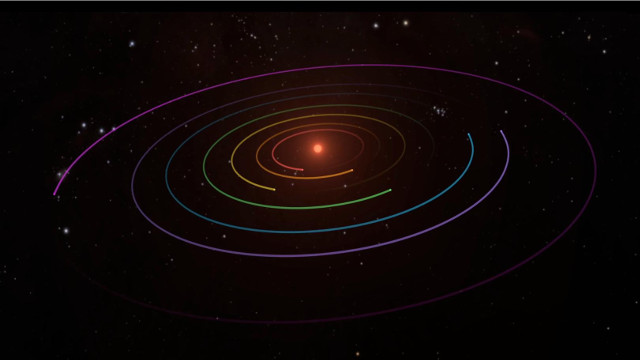
An article published in the journal “Nature Astronomy” reports a study on the formation of the planets of the ultra-cool star TRAPPIST-1’s system. A team of researchers exploited the particular configuration of the seven rocky planets to calculate how long their formation may have taken, obtaining a maximum value of a few million years, only a tenth of the time it took for the Earth to form. That’s because the resonance that exists between the planets can only have been maintained in the absence of a late bombardment of the kind that occurred in the solar system that completed its planets’ formation. One consequence is that water must have been absorbed by TRAPPIST-1’s planets during their formation in the protoplanetary disk.
The confirmation of the presence of seven rocky planets orbiting the tiny star TRAPPIST-1, announced on February 22, 2017, was extremely interesting news in the field of astronomy. This planetary system that is very compact because the planets are all very close to their star immediately became the subject of many studies also because it’s in the cosmic neighborhood since it’s about 39 light-years from Earth.
One of the results of the observations of TRAPPIST-1’s planets is the resonance between them. An article published in the “Astrophysical Journal Letters” in May 2017 indicated the orbital resonances between those planets. They’re very close to each other therefore they exert a reciprocal gravitational influence considerably higher than that existing between the solar system’s planets.
The resonance between TRAPPIST-1’s planets was exploited for this new study of their formation because it has precise implications on the processes that took place in that system and on the differences from what happened in the solar system. In particular, the authors of the study deduced that the planets weren’t subject to a late bombardment because it would have altered the orbits of the planets breaking their resonance. It’s not possible to calculate exactly how many materials between asteroids and comets hit the planets but the process must have lasted “only” a few million years.
This calculation indicates that materials such as water must have been incorporated into TRAPPIST-1’s planets in the course of their formation from the protoplanetary disk in which they were born. This confirms previous research that calculated a rather low density for some of those planets indicating a significant presence of water, for example, the one published in the journal “Nature Astronomy” in March 2018.
Planetary formation models indicate that an orbital resonance between planets may be normal soon after their formation but may also be altered by shifting orbits. Planetary migration is a topic of study in recent times, especially with regards to super-Earths and sub-Neptunians to understand their evolution. TRAPPIST-1’s planets may also have moved but their proximity may have maintained orbital resonance.
The researchers are aware that their results are approximate. New observations of TRAPPIST-1’s system may offer new information but the current instruments have their limitations. The new instruments that will come into service in the coming years will be able to provide higher quality information, for example by directly observing those planets’ atmospheres. We can expect new answers on the formation and evolution of this most interesting planetary system.
