
An article published in “The Astrophysical Journal” reports the discovery of an object orbiting BD+60 1417, a young star a little smaller than the Sun, which could be a gas giant planet but also a small brown dwarf. Amateur astronomer Jörg Schümann spotted a moving object by examining images in the “Backyard Worlds: Planet 9” program that anyone can participate in. A team led by Jackie Faherty of the American Museum of Natural History used various telescopes to confirm the existence of the object, cataloged as CWISER J124332.12+600126.2 or simply W1243. Its mass was estimated between 10 and 20 times the planet Jupiter’s, around the border between planet and brown dwarf, estimated around 13 Jupiter masses. The object had escaped previous research probably because its distance from its star is about 1660 times that of the Earth from the Sun.
About 146 light-years from Earth, the star BD+60 1417 has an estimated age of 100 million years, young in astronomical terms. A little smaller than the Sun, it’s interesting in the search for exoplanets because it’s a type of star that will live several billions of years, and being able to study the evolution of planets orbiting it could offer useful information to improve current models. For this reason, it has already been the subject of various studies but the outcome was negative. An amateur astronomer found an object around it.
The “Backyard Worlds: Planet 9” program is of the type open to so-called citizen scientists, people interested in participating in scientific research without being professionals in the field. In this case, five years of images collected by NASA’s WISE space telescope are available to anyone looking for planets that escaped professional astronomers’ search. Many eyes can achieve excellent results, and Jörg Schümann achieved one by discovering W1243.
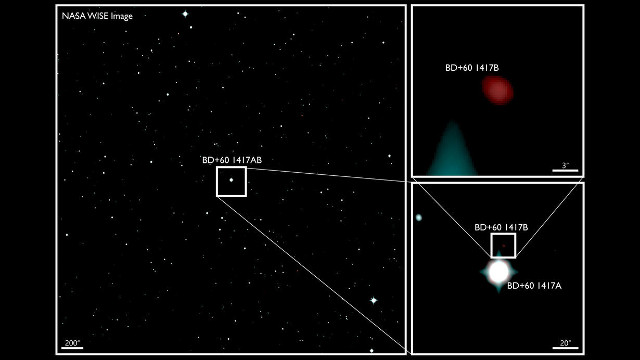
The image (Backyard Worlds / Léopold Gramaize) shows on the left the star BD+60 1417 seen by the WISE space telescope, on the bottom right the star and its companion, and on the top right a zoom on the object W1243. The system is indicated as binary and therefore as BD+60 1417AB with the star indicated as BD+60 1417A and W1243 indicated as BD+60 1417B.
W1243 is very far from its star, about 1660 times the distance of the Earth from the Sun. Its nature is still uncertain because its mass has been estimated very roughly between 10 and 20 times Jupiter’s. The boundary between planet and brown dwarf, an object halfway between planet and star, is estimated at a mass 13 times Jupiter’s but brown dwarfs have been discovered only a few decades ago and their limited emissions make their study difficult, so assessments on W1243 are still uncertain.
W1243 is in the cosmic neighborhood from an astronomical point of view but its distance from its star and its low emissions explain why it was discovered only recently. Follow-up infrared observations will help study this mysterious object.
