
Two articles – available here and here – published in the journal “Astronomy & Astrophysics” report aspects of a research on Sagittarius A*, the supermassive black hole at the center of the Milky Way. The GRAVITY collaboration and other researchers used ESO’s VLTI in Chile to observe stars around Sagittarius A* at a magnification 20 times greater than what was possible before the VLTI. This enabled to discover another star relatively close to the supermassive black hole, and by examining the orbit of that and other stars in that area, they estimated the mass of Sagittarius A* with greater precision.
Reinhard Genzel, director at the Max Planck Institute for Extraterrestrial Physics (MPE) in Garching, Germany, received the Nobel Prize in 2020 for his research on Sagittarius A*. That includes over thirty years of observing the stars orbiting it, as they can offer indirect but nonetheless valuable information about the supermassive black hole and test relativistic effects.
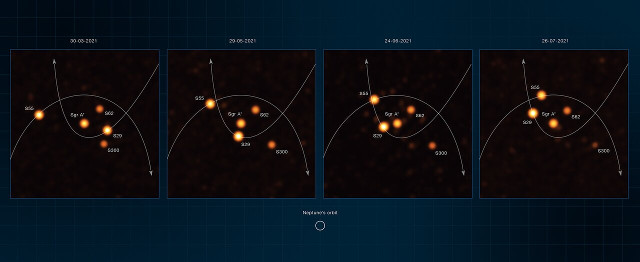
Increasingly powerful and sensitive instruments have been used to observe the stars orbiting Sagittarius A*. The Very Large Telescope Interferometer (VLTI) made it possible to obtain a magnification 20 times higher than the previous ones of that area using the GRAVITY instrument, which combines the observations of the four telescopes used by the VLTI. The results provided more precise information about the stars already known and to discover a hitherto unknown one, which was cataloged as S300.
The observations used for this study were conducted between March and July 2021. They include the star cataloged as S29, the one that came closest to Sagittarius A* at the end of May 2021 at about 13 billion kilometers. It may seem like a huge distance but its speed, measured at 8,740 kilometers per second, is the highest among the stars in the area because if it were lower the star would fall into the supermassive black hole.
The image (ESO/GRAVITY collaboration) shows some observations obtained with the GRAVITY tool of the area around Sagittarius A*. The orbital paths of the stars S55 and S29 are indicated with the lines. The small circle at the bottom indicates the amplitude of the planet Neptune’s orbit as a reference for the observed area’s size.
The study included creating a model that simulated the stars and was produced using a machine learning technique called Information Field Theory. For this purpose, past observations conducted using the old NACO and SINFONI instruments installed on the VLT and at the Keck and Gemini observatories in the USA were also used.
The comparison between the results of the simulations and the actual observations made it possible to follow the stars orbiting Sagittarius A* with a depth and precision never obtained before. The movements of the stars indicate that they’re orbiting a compact mass about 4.3 million times the Sun’s.
There may be other stars that pass even closer than S29 to Sagittarius A* but they’re too faint to be detected by current instruments. According to Frank Eisenhauer of MPE, principal investigator of the GRAVITY instrument, the update of this instrument and the activation of ESO’s new ELT telescope will enable even more in-depth research into the central area of the Milky Way and its supermassive black hole in the next decade. Among other things, it may become possible to measure how fast Sagittarius A* spins.
Studies of supermassive black holes have various ramifications. These are extreme objects that can help test the limits of our current knowledge in physics. Their influence on the evolution of the galaxies that host them and in particular on star formation is currently an important field of astronomical studies.
