
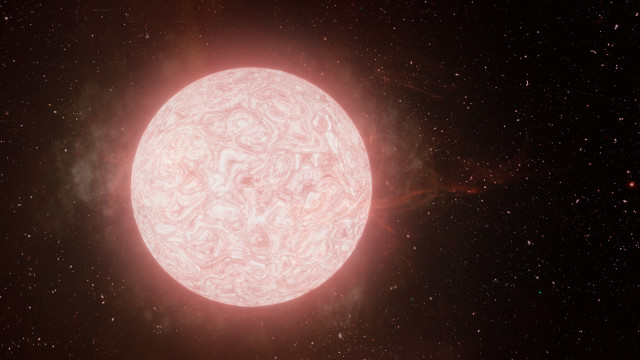
An article published in “The Astrophysical Journal” reports the observations of the supernova cataloged as SN 2020tlf, the first case in which astronomers observed a red supergiant star in the period immediately preceding the explosion. A team of researchers used the Pan-STARRS telescope in Hawaii to detect the changes taking place in the red supergiant in the summer of 2020 and then used the NIRES and DEIMOS instruments of the Keck Observatory, also in Hawaii, for the first spectrographic detections of the supernova emissions in the fall of 2020. Subsequently, other instruments added data on the supernova. Astronomers expected a red supergiant to go through a quiet period before exploding, but SN 2020tlf’s progenitor emitted strong radiation in the last year of its life.
Red supergiants are the last stage of life of massive stars before exploding into supernovae. Observations of this type of dying star and supernovae allowed to build models of the processes that occur just before the explosion but they’re still incomplete. At the moment, it’s impossible to say with a good approximation when a star is about to explode, which is why there has been a lot of speculation recently about the possible imminent death of Betelgeuse.
Wynn Jacobson-Galán, the lead author of the article and then at Northwestern University’s CIERA (Center for Interdisciplinary and Exploratory Research in Astrophysics), and other authors of this study are members of the Young Supernova Experiment, which uses the Pan-STARRS telescope to detect supernovae right at the moment of their explosion. Its red sensitivity made it possible to detect the red supergiant progenitor star of the supernova SN 2020tlf a few months before its explosion.
When that star exploded in the fall of 2020, observations could be obtained very quickly using the Keck Observatory’s NIRES (Near Infrared Echellette Spectrograph) and DEIMOS (Deep Imaging and Multi-Object Spectrograph) instruments. The monitoring continued, also with the addition of other instruments that in the meantime got aimed at the supernova SN 2020tlf.
The data collected indicate that the supernova SN 2020tlf occurred in the galaxy NGC 5731, about 120 million light-years from Earth and that its progenitor star had a mass about 10 times the Sun’s. In other cases, supernovae were identified soon after the explosion, and subsequently, the relative progenitor stars were identified. In this case, there were specific observations of the progenitor star and the processes that marked the end of its life.
The surprise came from the fact that the progenitor star emitted strong electromagnetic radiation in the period preceding the explosion. Astronomers thought that that period was a kind of quiet before the storm but this hypothesis has been contradicted by observations. Professor Raffaella Margutti of Northwestern University, one of the authors of this study, stated that it’s like watching a ticking time bomb.
Observations of the supernova SN 2020tlf and its progenitor star will help improve models describing the processes that lead to the explosion of massive stars. The data relating to the events leading up to the explosion will also help find other red supergiants at the end of their lives. These are steps forward in understanding the processes that include the production of heavy elements that are ejected into interstellar space and may contribute to the formation of other planets.
