

An image captured by ESA’s Mars Express space probe’s High Resolution Stereo Camera (HSRC) shows the Jovis Tholus shield volcano on Mars and the surrounding area with its geological features. The Tharsis region where Jovis Tholus is located includes some large volcanoes, first of all, Olympus Mons, the largest volcano in the solar system. Jovis Tholus’s interconnected calderas indicate a long period of volcanic activity and the more recent ones, each of which has a slightly lower floor, end up meeting even more recent lava flows. At 1,500 meters high and 58 kilometers in diameter, Jovis Tholus is much smaller than Olympus Mons yet provides a lot of information about the geology of the Tharsis region and its volcanic activity.
Mars’ ancient volcanic activity is being studied by researchers using photos taken by various space probes orbiting the red planet. Mars Express captured a great many of them in the many years spent observing Mars, where it arrived in 2003, and in 2021 it took photos of the area around Jovis Tholus useful for this type of research.
A reason of interest for Jovis Tholus is its system of calderas, at least 5 of which the largest is about 28 kilometers wide, a little off the volcano’s center. The top image (ESA/DLR/FU Berlin, CC BY-SA 3.0 IGO) offers an oblique perspective view created from photos taken by the Mars Express space probe.
The younger calderas of Jovis Tholus descend towards the youngest of the impact craters in the area and meet the sea of even more recent lava flows that mark the region. The original relief of this volcano is now only about a kilometer above the plains that surround it due to those ancient lava flows that covered the oldest craters.
Jovis Tholus is on the northern edge of an extensive lava plain south-east of the Ceraunius Fossae graben-type geological features system and north-east of the Ulysses Fossae graben system. It’s a shield volcano, formed by flows of fluid, low-viscosity lava.
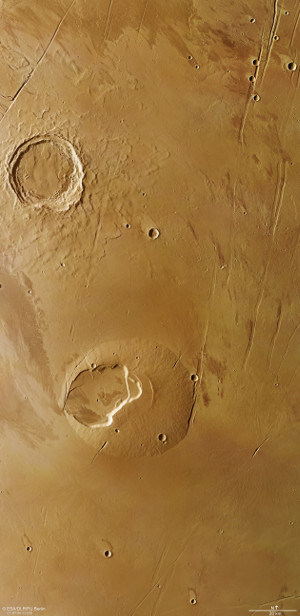 About 60 kilometers from Jovis Tholus there’s a large impact crater with a diameter of about 30 kilometers, visible in the side image (ESA/DLR/FU Berlin, CC BY-SA 3.0 IGO) above the volcano. The fractured background and the nature of the materials ejected around the crater give it the shape of a flower with many layers of petals. This suggests that the meteorite or comet that spawned it hit an area of ground saturated with water, possibly frozen, that was at least partially vaporized following the impact. The presence of water in the area is another interesting element for research.
Together with the other volcanoes of Tharsis, Jovis Tholus offers information on the history of the volcanoes of Mars, whose past activity is important to understand the red planet’s evolution. Today we know that a long time ago, Mars was geologically active, and understanding the processes that led to its current situation means better understanding the planet’s geology and history.
