Two articles – available here and here – published in “The Astronomical Journal” report studies on as many exoplanets of the mini-Neptune type that are losing their atmosphere. Two teams led by Michael Zhang with other members in common used the Hubble Space Telescope to study the exoplanet HD 63433c and the Keck Observatory in Hawaii to study the exoplanet TOI 560.01, also known as HD 73583b. In both cases, the XMM-Newton space telescope was used to study the high-energy emissions from their stars and from the outflow of gas from their atmospheres. Observations of gas leaking into space is a confirmation of the theory that mini-Neptunes can transform into super-Earths at the end of that loss.
Mini-Neptunes are interesting planets because they have mass and size much higher than those of the Earth, even higher than the super-Earths discovered over the years, but definitely lower than those of Neptune, not to mention gas giants like Jupiter. For this reason, they’re sometimes called gas dwarfs.
Mini-Neptunes constitute a class of planets discovered only thanks to the study of other planetary systems, and the boundary with super-Earths hasn’t been clearly defined. That’s one of the reasons why it’s been hypothesized that mini-Neptunes could lose their atmosphere due to their stars’ emissions, transforming over time into rocky planets. These new studies concern two planets of this class that show gas outflows indicating atmospheric leaks.
About 73 light-years away from Earth, the exoplanet HD 63433c has a diameter that is approximately 2.67 times the Earth’s and one day that lasts 20.5 Earth days. It orbits a star that is slightly smaller and less massive than the Sun but much younger, as its system is estimated to be around 440 million years old. Its discovery was announced in 2020 along with that of another mini-Neptune even closer to their star.
About 103 light-years from Earth, the exoplanet TOI 560.01, also known by the catalog designation HD 73583b, has a diameter that is approximately 2.8 times the Earth’s and a day that lasts 6.4 Earth days. It orbits a star that has a mass that is about two-thirds of the Sun’s and a diameter that is about 71% of the Sun’s. This system is also much younger than the solar system with an estimated age of around 750 million years. Its discovery was announced in 2021 along with that of another very similar exoplanet farther from their star.
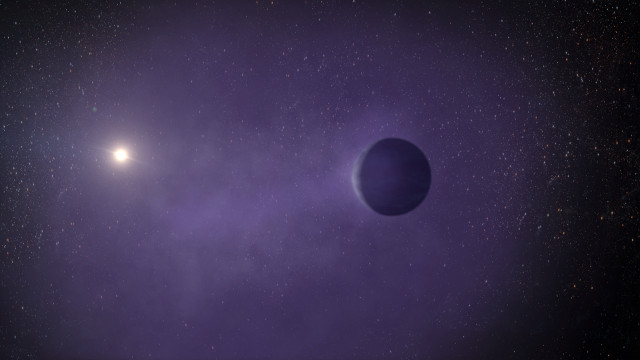
The two mini-Neptunes objects of the respective articles are astronomically young and both show a loss of atmosphere. Due to their proximity to their stars, that atmosphere is heated considerably, so it’s “puffed up” and is exposed even more to stellar emissions. However, these two exoplanets aren’t massive enough to hold onto that huge gas envelope, which is slowly dispersing.
A surprising result is the observation of gas outflow from the exoplanet TOI 560.01 moving towards its star. The researchers expected it to be pushed by the stellar wind in the opposite direction but it would appear that the star’s gravity is more powerful. It will be necessary to understand whether that’s an exception or if it’s normal for the atmospheric gas lost by mini-Neptunes to move towards their stars.
Studies of exoplanets HD 63433c and TOI 560.01 offer the first direct evidence that mini-Neptunes can transform into rocky planets. These two, in particular, will become super-Mercuries due to proximity to their stars but other similar planets in their star system’s habitable area could become habitable by Earth-like life forms. That’s one of the reasons why studies continue.
