
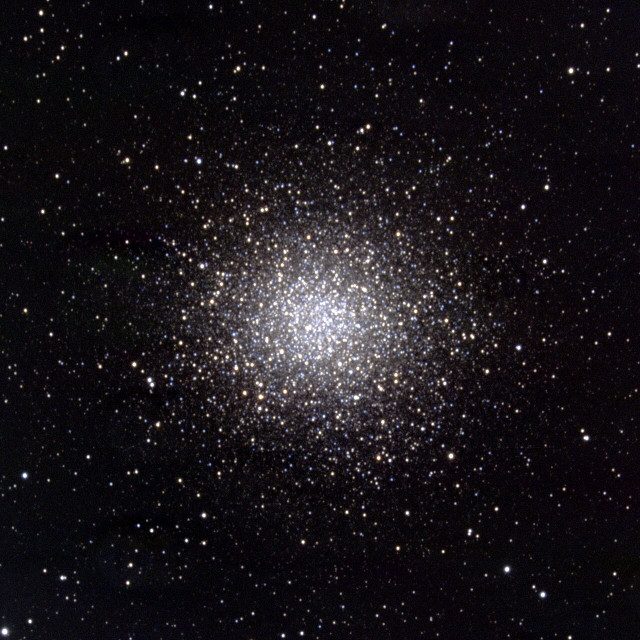
An article published in “The Astrophysical Journal” reports the results of observations of the globular cluster M14. A team of astronomers led by Francesca D’Antona of the Italian National Institute of Astrophysics, Rome, used the Hubble Space Telescope to study M14, discovering that over a third of the stars in M14 contains an amount of helium never observed outside globular clusters, as it has peaks higher than 30% of their mass. According to the researchers, the most likely explanation is that these are second-generation stars that swallowed the helium ejected by first-generation stars during their agony.
About 30,000 light-years away from Earth, M14, also known as NGC 6402, is a globular cluster, a group of stars with strong gravitational bonds that form a spheroidal shape. It contains hundreds of thousands of stars which make it one of the most massive in the Milky Way but it’s difficult to study because between the Earth and M14 there’s the Rho Ophiuchi Cloud, a gigantic molecular cloud full of gas and dust that blocks many electromagnetic emissions coming from the globular cluster.
Despite the problems in obtaining observations of adequate quality, Francesca D’Antona’s team conducted a study that started with the reconstruction of the Rho Ophiuchi Cloud’s structure. This result was obtained using a new technique and observations conducted with the Hubble Space Telescope’s WFC3 (Wide Field Camera 3) instrument and this allowed to eliminate its light leaving in the observations the emissions coming from the globular cluster M14.
The analysis of M14’s data collected with the Hubble Space Telescope indicates that over a third of the stars in this globular cluster contains an extraordinary amount of helium, with peaks exceeding 30% of their mass. It’s not the first time such cases have been discovered in a globular cluster. For example, NGC 2808 contains stars with helium peaks much higher than those that can be explained by normal processes.
The explanation proposed by Francesca D’Antona and her collaborators is that the stars with high helium content constitute the second generation in the globular cluster M14. This group of stars was born about 13 billion years ago and there was probably a first generation that contained a normal amount of helium. When massive first-generation stars went into agony and then exploded into supernovae, they started shed ejecting helium into interstellar space. The second generation of stars may have swallowed an abnormal amount of helium.
This study of the globular cluster M14 offers new information useful to understand what processes may take place in the formation of stars within these groups of stars. These are very ancient stars that are studied with interest primarily because they help to understand the formation of the first stars, which took place a few hundred million years after the Big Bang.
