
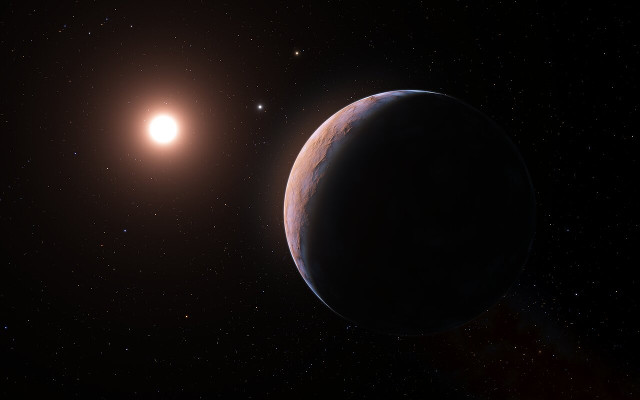
An article published in the journal “Astronomy & Astrophysics” reports the discovery of another rocky planet in the Proxima Centauri system. A team of researchers led by João Faria of the Instituto de Astrofísica e Ciências do Espaço, Portugal, used detections conducted with the ESPRESSO spectrograph mounted on ESO’s VLT in Chile to find the traces of the planet that was cataloged as Proxima d. This is the exoplanet with the smallest mass identified with the radial velocity method since the estimated minimum mass is about a quarter of the Earth’s, twice Mars’s. Its distance from Proxima Centauri is around 4 million kilometers, so it’s more similar to Venus or Mercury.
Proxima Centauri is the closest star to the solar system but identifying planets orbiting this red dwarf is difficult because they have very little chance of passing in front of their star from the Earth’s point of view. For this reason, Proxima Centauri has been studied with spectrographs that can exploit the radial velocity method. Over the past few years, these efforts led to the discovery of two planets in that system, and now João Faria’s team reported the identification of a third planet.
The effect of the exoplanet Proxima d on its star is minimal, and that made it difficult to detect it with the radial velocity method. The researchers needed a very advanced spectrograph such as ESPRESSO (Echelle SPectrograph for Rocky Exoplanets and Stable Spectroscopic Observations), installed on the Very Large Telescope (VLT) and activated almost exactly four years ago. It took several detections to convince the researchers that the spectrographic signals were actually produced by the presence of a planet and not by other phenomena.
Proxima d is the exoplanet with the smallest mass discovered using the radial velocity method. The indirect discovery offers limited information about an exoplanet that is calculated based on its effects on its star. The estimated mass, in this case about a quarter of the Earth’s, is the minimum but could be significantly higher. The mass is that of a rocky planet but direct observations are needed to obtain information on its characteristics.
The data collected indicate that the exoplanet Proxima d has a year that lasts just over 5 Earth days for a distance of about 4 million kilometers from the star Proxima Centauri. This means that Proxima d is too close to its star to be in its system’s habitable area. Red dwarfs are small stars but they can be very active, so Proxima d is also likely to be hit frequently by very violent flares.
Without direct observation, it’s impossible to say if the exoplanet Proxima d has an atmosphere. Its reduced mass makes the presence of a planetary core capable of generating a magnetic field to protect it less likely. The combination of low mass and exposure to violent star flares reduces the likelihood that Proxima d has an atmosphere. It may have had one in the past that was blown away by star winds and flares as happened to Mars. This means that it’s probably similar to Mercury.
The article that reports the discovery of Proxima d defines it as a candidate even if the probabilities that it’s actually an exoplanet are very high. Caution is normal in these cases of indirect discovery, awaiting confirmation from other teams who will probably only be able to try another measurement of the radial velocity with other spectrographs. For now, this seems like an excellent result obtained with the ESPRESSO spectrograph that offers new information on the Proxima Centauri system and new perspectives for the search for exoplanets, even small ones, orbiting red dwarfs.
