
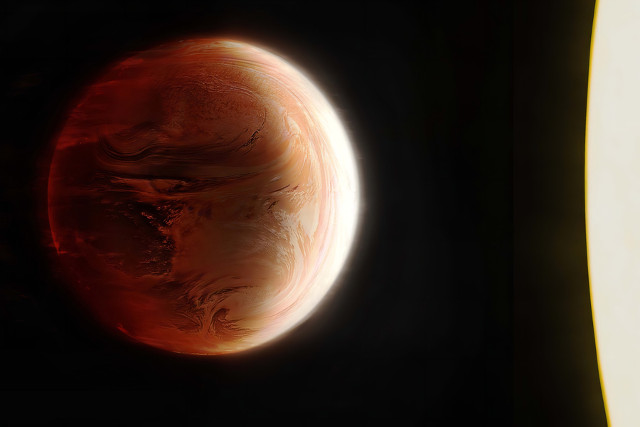
An article published in the journal “Nature Astronomy” reports the results of a new study on the exoplanet WASP-121b, an ultrahot Jupiter considered one of the planets with the most extreme conditions known. A team of researchers led by Tom Evans, today at the Max Planck Institute for Astronomy in Heidelberg, Germany, used data collected by the Hubble Space Telescope to investigate compounds present in WASP-121b’s atmosphere. The conclusion is that there may be clouds of iron, titanium, and corundum, the crystallized form of aluminum oxide that makes up rubies and sapphires.
About 900 light-years away from Earth, the exoplanet WASP-121b has a mass slightly higher than Jupiter’s but its size is almost twice due to the very high temperatures that heat the gases that form it and inflate them. In fact, That’s because it’s very close to its star, to the point that a year lasts about 30 hours. Its discovery was announced in March 2016 and its extreme conditions stimulated some interest from astronomers with the consequence that it’s been the subject of several studies.
Tom Evans has participated in several studies on the exoplanet WASP-121b, for example, the one that presented evidence that it has a stratosphere. Despite its relative proximity, it’s not easy to obtain precise information on its atmosphere that allows understanding what processes are in progress and what compounds formed inside it. The situation is complicated by the fact that it’s tidally locked and consequently always shows the same face to its star, so the conditions are very different on the day and night side.
Years of observations have made it possible to collect a lot of information about the exoplanet WASP-121b using the Hubble Space Telescope and other instruments such as the HARPS spectroscopes, mounted on ESO’s 3.6-meter telescope at the La Silla Observatory, and ESPRESSO, mounted on the VLT, also from ESO. Further surveys carried out for this study concern two complete revolutions between 12 and 13 March 2018 and between 3 and 4 February 2019. The information collected concerns both the day and the night side.
Analysis of the data indicates that there’s a significant difference in temperature between the day and night side of exoplanet WASP-121b but also between different atmosphere layers on the same side. On the dayside, temperatures at the deepest levels are around 2,500 Kelvin to reach 3,500 Kelvin in the upper layers. On the night side, temperatures range from 1,500 Kelvin in the deepest layers to 1,800 Kelvin in the upper layers.
The researchers expected a temperature peak in the atmosphere of the exoplanet WASP-121b at the zenith, the area just in front of its star. Actually, they detected it in an area a little east of the zenith. The conclusion is that atmospheric winds blow at such a speed that they carry the heat so quickly that it reaches a considerable distance before significantly dispersing it. The speed of that wind was calculated to be 5 kilometers per second, which is 18,000 kilometers per hour.
Under the conditions present on the exoplanet WASP-121b, really exotic physical and chemical processes can take place. Water molecules are broken apart on the dayside and can reform on the night side. Spectrographic data suggest the presence of clouds of iron, titanium, and corundum that evaporate on the dayside and could generate rain on the night side. Basically, it’s possible that there are rains of rubies and sapphires.
Extreme exoplanets such as WASP-121b show environments where physical and chemical processes that are impossible even in the most extreme places in the solar system take place. That’s because in ultrahot Jupiters there’s a combination of factors regarding mass and proximity to a star, in this case, hotter than the Sun, which is not easy to find. Now that the James Webb Space Telescope has finally been launched, even more in-depth studies of this exoplanet could be conducted.
