An article published in the journal “Astronomy & Astrophysics” reports the most detailed view ever obtained of remains inside the galaxy cluster Abell 3667 with a shock wave that expands over about 6.5 million light-years, the largest ever identified. A team of researchers led by Francesco de Gasperin of the Italian National Institute of Astrophysics used the MeerKAT radio telescope to obtain detailed images of a shock wave generated by the collision between two galaxy clusters that occurred over a billion years ago.
Interactions between galaxies are common but there are cases where the interactions involve entire clusters. When the interactions become mergers, one of the consequences is the emission of shock waves that pass through the cluster that has formed. Francesco Gasperin explained that those shock waves act as particle accelerators that push electrons to speeds close to the speed of light. When those electrons pass through a magnetic field, they emit radio waves and this allows them to be detected with their magnetic field lines and the regions where the electrons are accelerated.
Abell 3667 is a galaxy cluster that is part of an even more colossal formation, the so-called Microscopium Supercluster. It’s so vast that it has not yet been ascertained which clusters exist in that area of the universe are part of it and which ones are relatively close to it but are not gravitationally bound to it. Getting these kinds of answers with certainty about a formation over a billion light-years away that spans over 300 million light-years is a long and complex task.
Among the certainties obtained by astronomers there’s a clash between galaxy clusters that took place over a billion years ago that gave rise to the new cluster cataloged as Abell 3667. Obtaining images that include an extended object such as a galaxy cluster and at the same time are very detailed is usually impossible for radio astronomy instruments. However, the MeerKAT radio telescope is a precursor to the next-generation SKA radio telescope and was designed to achieve both results. Another possibility offered by MeerKAT is to study the polarization of the detected radio waves. This allows us to study cosmic magnetic fields.
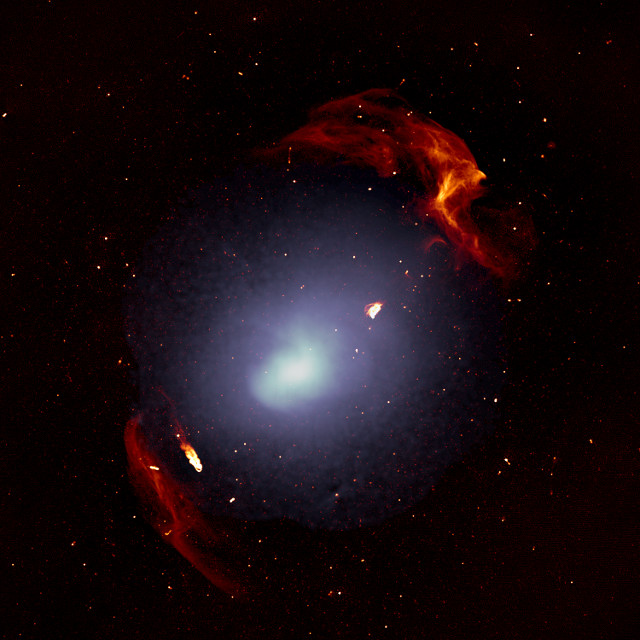
The top image (Francesco de Gasperin, SARAO) shows the galaxy cluster Abell 3667 as a whole, as the individual galaxies are too small to be visible. In white, the gas present in the space between its galaxies. In red, the two main shock waves generated during the merger between two clusters.
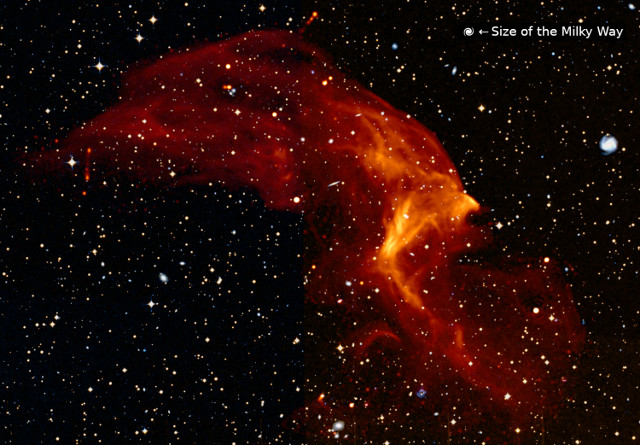
The bottom image (Francesco de Gasperin, SARAO) shows a detail of one of the two largest shock waves with its filamentous structure in evidence. Many galaxies are also visible but most are not part of the Abell 3667 cluster. Above, slightly to the right, a representation of the Milky Way as it would be seen if it were at the same distance as the shock wave.
The radio observations of the shock waves in the galaxy cluster Abell 3667 made it possible to establish that they’re still propagating in the plasma present between galaxies. Their speed is very high, estimated at around 1,500 kilometers per second. Actually, there’s not a single shock wave but a collection of smaller shock waves of different intensities. The main shock wave passes through Abell 3667 for a size of about 6.5 million light-years, about sixty times the Milky Way’s diameter.
This study on the consequences of the formation of the galaxy cluster Abell 3667 will be useful to improve the models concerning the mergers of clusters and the shock waves that are generated as a result. These events have consequences on the largest structures in the universe and also on star formation within the galaxies that are part of it, therefore their study is useful in various types of research.