
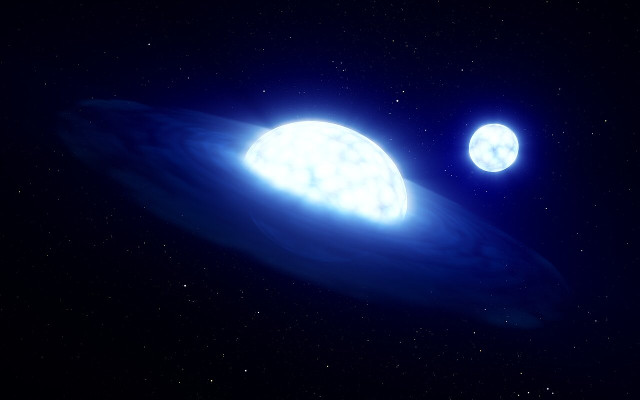
An article published in the journal “Astronomy & Astrophysics” reports a new study on the HR 6819 system that offers a more convincing explanation than the one proposed in 2020, when the presence of a black hole was proposed as part of a triple system. A team of researchers led by Abigail Frost of Ku Leuven, Belgium, which includes members of the team that claimed the black hole’s presence and members of the team that already offered an alternative explanation, used new observations obtained with ESO’s VLT that include the use of the VLTI interferometer to try to get a final answer. The conclusion is that HR 6819 is a binary system in which there is no black hole but there is a phenomenon of stellar vampirism in which one of the two stars has torn large quantities of hydrogen from its companion.
The reconstruction of the structure of the HR 6819 system with the presence of a black hole 1,000 light-years from Earth and therefore in the cosmic neighborhood generated considerable interest in the field of astronomy after its publication in “Astronomy & Astrophysics” in May 2020. However, in another article published in September 2020 in “Astronomy & Astrophysics,” a team led by Julia Bodensteiner, then a Ph.D. student at Ku Leuven, offered a different interpretation of the data that didn’t include a black hole.
In the interpretations provided by the two teams, there were two stars but one team proposed that the two stars were far from each other and there was also a black hole while the other team proposed the presence of two stars close to each other and that one had torn off hydrogen from its companion.
Abigail Frost explained that the researchers had reached the limit of existing data so they had to resort to a different observational strategy to decide between the two scenarios proposed by the two teams. For this reason, the two teams joined forces and worked together to obtain new, sharper images of the HR 6819 system, an achievement thanks to ESO’s Very Large Telescope (VLT) in Chile.
The VLTI interferometer that makes it possible to combine the observations of different telescopes of the observatory was also used to collect the data: specifically, the researchers used the VLTI’s GRAVITY instrument and the VLT’s MUSE (Multi Unit Spectroscopic Explorer) instrument. This combination was crucial in obtaining the necessary data for the new study because MUSE confirmed that there was no bright companion on a wider orbit while GRAVITY’s high spatial resolution made it possible to resolve two light sources separated by only one-third of the distance between the Earth and the Sun. In essence, it was the data that Abigail Frost called the last piece of the puzzle that allowed her team to conclude that HR 6819 is a binary system in which there is no hole black.
The new results confirm the theory that HR 6819 is a case of stellar vampirism. This type of phenomenon had already been described years ago but the phase now visible from the Earth has a very short duration, so observing it is very difficult. This means that a system that seemed interesting for one reason is actually interesting for a very different reason.
Astronomer Thomas Rivinius, who led the team that proposed the presence of a black hole in the HR 6819 system, wasn’t surprised by the reactions to his team’s proposal and stated that the results of such a research must be scrutinized, even more, a result that appears on the front page. His is a rigorous interpretation of the scientific method which, through verifications and, in this case, the collection of new data, led to the solution that now seems correct.
Thomas Rivinius also commented on the difficulty of detecting stellar-mass black holes, which tend to offer no traces if they don’t have an influence on other objects in binary or multiple systems. There could be millions of them in the Milky Way alone, and their search continues. In the meantime, the study of the HR 6819 system will continue as well but for very different reasons, namely to collect data on the evolution of massive stars in a case of stellar vampirism.
