
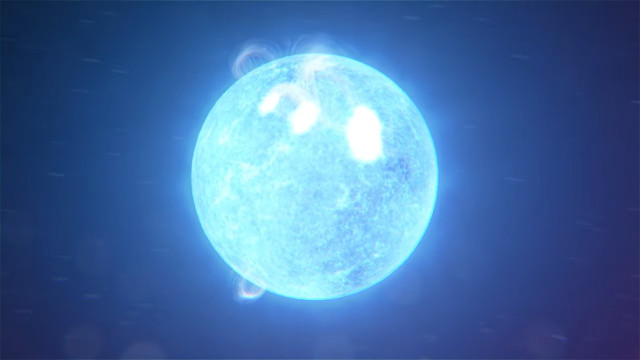
An article published in “The Astrophysical Journal Letters” reports a study on the magnetar cataloged as SGR 1830-0645, or simply SGR 1830, and spots on its surface that generated X-ray emissions. A team of researchers used the NICER telescope installed on the International Space Station to monitor the outbursts on the surface of SGR 1830 and the merger of three spots into one. More data was collected thanks to NASA’s Swift Space Telescope. The conclusion is that this is an activity that has similarities with the movements of tectonic plates on Earth. The magnetic field of the magnetar can cause its surface to deform, crack, and even melt even though it’s extremely hard. Spots are areas where Sun-like coronal loops connect to the surface.
The outbursts on the surface of the magnetar SGR 1830 were initially detected on October 20, 2020. This neutron star has a still roughly known distance that is estimated to be around 13,000 light-years from Earth. It’s a magnetar because it has an extraordinarily powerful magnetic field, the most powerful known.
The Swift Space Telescope detected repeated emissions from the magnetar SGR 1830 that revealed that it spins once every 10.4 seconds. On the same day, the NICER (Neutron Star Interior Composition Explorer) instrument, a telescope installed on the International Space Station to study neutron stars, detected that activity. NICER showed that the X-ray emissions indicated three close peaks with each rotation. The spots were regions much hotter than the surrounding ones, with temperatures of several million degrees Kelvin.
The NICER instrument made it possible to monitor the activity on the surface of the magnetar SGR 1830 until November 17, when the Sun became too close from the International Space Station’s point of view to continue the observations safely. Over the course of nearly a month, the emissions showed a shift of the spots as a result of movements in the crust of SGR 1830. These are movements similar to those of tectonic plates on Earth but a neutron star’s crust is extremely hard and probably only the very powerful magnetic field of a magnetar broke it.
According to the researchers’ reconstruction, the crust of the magnetar SGR 1830 was broken and partially melted, deforming under the stress generated by the magnetic field. The spots that formed have similarities with the Sun’s plasma arcs and in this case, they moved until they merged into a single spot.
Magnetars are extreme objects even by neutron star standards with conditions unimaginable in the entire solar system. Observations of events such as the birth and evolution of spots such as those discovered on the magnetar SGR 1830 can help to better understand the environment existing on the surface of that type of object, in particular the interaction between the crust and the magnetic field. It’s a sort of cosmic laboratory where it’s possible to conduct tests of physical and astrophysical models that are impossible on Earth.
