
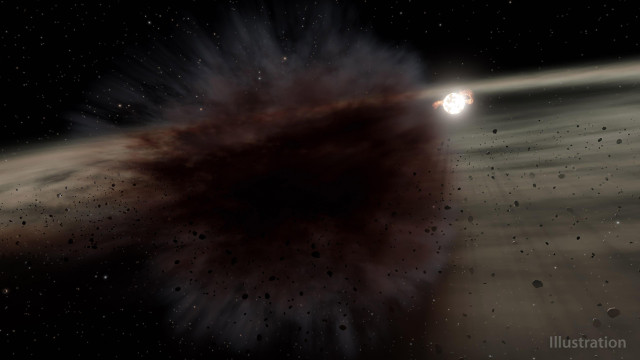
An article published in “The Astrophysical Journal” reports a study on the star system cataloged as HD 166191, which has an estimated age of 10 million years and is still in its formation process with objects that form but also get destroyed following collisions. A team of researchers led by Kate Su of the University of Arizona used data collected between 2015 and 2019 using NASA’s Spitzer Space Telescope and ground-based telescopes to detect traces of debris clouds generated by collisions between planetesimals. The information obtained from these data is very useful to improve our knowledge of the formation and evolution of planetary systems.
The Spitzer Space Telescope mission ended in January 2020 but the wealth of data continues to be examined. That’s all the more true when an object has been continuously observed over the course of a few years. About 330 light-years away from Earth, the young star HD 166191 is a bit more massive than the Sun and was among the objects of Spitzer observations between 2015 and 2019.
Over the course of millions of years, in a protoplanetary disk around a star, gas, and dust begin to coalesce, and after various stages of growth, some of those materials can form planets. An intermediate phase of this process is that of planetesimals, large asteroids composed of rocks and frozen water. However, the formation of the various objects is chaotic and it’s normal for many collisions to occur and generate clouds of debris. The more than 100 observations of HD 166191’s system that began in 2015 provided evidence of that type of collision, probably between planetesimals.
In particular, in 2018, variations in the brightness of the star HD 166191 were noted which were attributed to clouds of debris that blocked part of its light for a while and then dispersed. More data was found in the archives of the All-Sky Automated Survey for Supernovae (ASAS-SN) program, which aims to search for supernovae but can be useful for other astronomical research as well, and thanks to the Hereford Arizona Observatory (HAO).
The analysis of the data suggests that the cloud generated in 2018 had a very elongated shape and only a small part passed in front of the star. Perhaps the total area occupied by the cloud was hundreds of times larger than the star’s. Such a vast cloud could only have been produced by a collision between objects of at least the size of planetesimals.
That collision may have caused some sort of chain reaction with fragments hitting other smaller asteroids over a large area. This makes it more difficult to estimate the size of the planetesimals that initiated this destruction but may have been in an advanced stage of formation. In this case, their size would be comparable to that of Vesta, one of the largest objects in the asteroid belt between Mars and Jupiter with its 530 kilometers in diameter and on the border between the asteroid and the dwarf planet category.
The observations conducted in the following period made it possible to evaluate the evolution of the situation in the HD 166191 system. The data collected suggest that the debris dispersed rapidly, leading to a growth of the cloud over the following months. However, in early 2019, the cloud was no longer visible and at the same time observations indicated that the amount of dust had doubled.
The study of this type of collision offers information to improve the models about planetary systems’ birth and evolution. Many other systems in various stages of formation are known and those collisions are very common, so there’s hope that more will be discovered. The Moon was probably born from the consequences of the impact of a planet with the primordial Earth and the Pluto-Charon pair could have been generated by another similar impact. That shows how this type of study concerns processes that influenced the history of the solar system and the Earth as well.
