
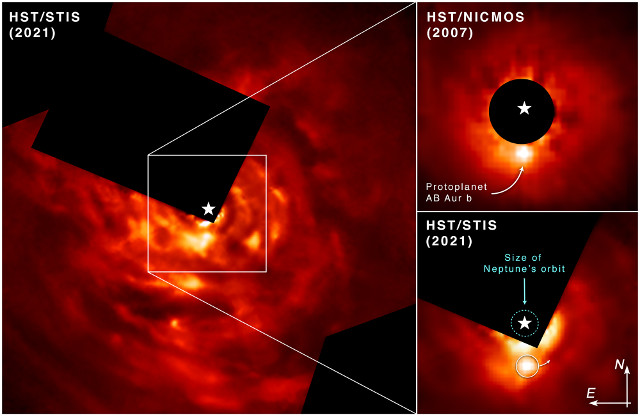
An article published in the journal “Nature Astronomy” reports a study on the protoplanet cataloged as AB Aurigae b, a gas giant that is growing following an unusual process called disk instability. A team of researchers used observations made with the Hubble Space Telescope and the Subaru Telescope on Mauna Kea, Hawaii, between 2007 and 2021 to find evidence of that violent formation. Proving that gas giants can form as a result of disk instability will help better understand the history of the solar system as well.
Planetary formation models have become more sophisticated over time but the main one remains the slow growth model with a progressive accretion of materials around a protoplanetary core. The discovery of many protoplanetary disks that in various cases show processes of planetary formation in progress made it possible to collect evidence of this model but also clues to the possibility that planets could also form in other ways.
The star system AB Aurigae, very young in astronomical terms, shows a planetary formation of a different type, much more chaotic and violent. For this reason, it was already studied and in May 2020 it was announced that a protoplanet was photographed. According to the disk instability model, gas giants can form within massive protoplanetary disks in which gravitational tensions cause them to fragment into parts with big masses that can coalesce relatively quickly.
To find evidence of an ongoing disk instability process it’s necessary to obtain observations over long periods that show motions within the protoplanetary disk. The longevity of the Hubble Space Telescope was crucial to achieving this result. Two Hubble instruments, STIS (Space Telescope Imaging Spectrograph) and NICMOS (Near Infrared Camera and Multi-Object Spectrometer) were used to observe the AB Aurigae system between 2007 and 2021. More data was collected thanks to the SCExAO instrument on the Subaru telescope, which aims to photograph exoplanets directly.
The image (Science: NASA, ESA, Thayne Currie (Subaru Telescope, Eureka Scientific Inc.). Image processing: Thayne Currie (Subaru Telescope, Eureka Scientific Inc.), Alyssa Pagan (STScI)) shows the AB Aurigae system photographed by the Hubble Space Telescope at various times in 2007 and 2021.
The images collected allowed to examine the dynamics in the protoplanetary disk around AB Aurigae. The fact that this forming system is visible almost face-on from Earth is an advantage in examining its evolution. The longevity of the Hubble Space Telescope made it possible to have images showing the situation of the disk over a decade away. That’s a very short time in astronomical terms but sufficient for chaotic processes such as the movements that offered evidence of the formation of a planet.
The protoplanet cataloged as AB Aurigae b isn’t yet complete yet its mass was estimated to be about ten times Jupiter’s. Its distance from its star is more than twice the distance of Pluto from the Sun and according to the models, at that distance, it would take a very long time for the formation of a gas giant by core accretion.
This study brings evidence regarding the disk instability model and useful observations to refine it. This will help to understand which planets form one way and which ones form another way. It will also help to better understand the formation of the solar system and to establish whether and possibly which gas planets may have formed as a result of disk instability.
