
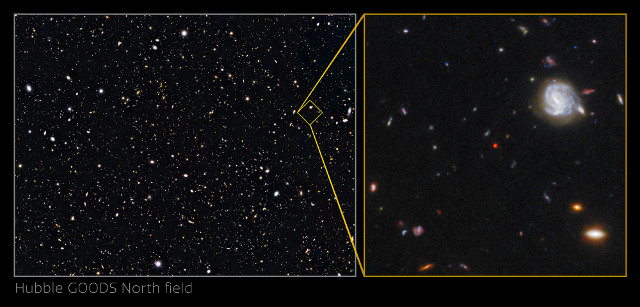
An article – link to the file in PDF format – published in the journal “Nature” reports the discovery of a possible precursor of a supermassive black hole in the early universe. A team of researchers discovered the object cataloged as GNz7q in the data of the GOODS survey conducted by combining observations made with different telescopes. From Earth, we see GNz7q as it was about 750 million years after the Big Bang and its emissions can only be partially explained by a remarkable star formation. The conclusion is that there’s probably a supermassive black hole growing within the dust that fills up the primordial galaxy’s nucleus and over time it will become a quasar, a type of extremely bright active galactic nucleus.
The formation of supermassive black holes has for now only theoretical explanations but so far a precursor has never been identified to offer the possibility of testing the proposed models. The situation could change after the likely identification of one of these precursors in the GOODS-North (Great Observatories Origins Deep Survey-North) field, part of a survey conducted with the Hubble, Spitzer, Herschel, XMM-Newton, and Chandra space telescopes and some ground-based telescopes.
The object cataloged as GNz7q appears to have the characteristics predicted for a supermassive black hole precursor, which could begin its life in the dust-filled nucleus of a so-called starburst galaxy, which is the type marked by a remarkable star formation rate. According to the theoretical models, over time, the precursor ends up wiping out the dust it didn’t swallow becoming a quasar, in which the supermassive black hole heats the dust left around it to the point that it generates very powerful electromagnetic emissions.
Over time, astronomers discovered dusty starburst galaxies and very bright quasars but not the possible missing link between these two types of galaxies. GNz7q could finally be this type of galaxy with the quasar precursor showing a light that gives it the reddish color present in the inset on the right side of the image (NASA, ESA, Garth Illingworth (UC Santa Cruz), Pascal Oesch (UC Santa Cruz, Yale), Rychard Bouwens (LEI), I. Labbe (LEI), Cosmic Dawn Center/Niels Bohr Institute/University of Copenhagen, Denmark) without being as bright as a quasar in its full activity.
According to the models, this type of precursor is expected to be bright under ultraviolet and X-rays but no X-rays were detected by GNz7q. Those emissions could be blocked by the dust surrounding the burgeoning black hole while ultraviolet rays can be detected because they are generated in an area outermost of the dust disk around the black hole.
GNz7q was hidden in plain sight in the sense that the GOODS survey covered an area observed by several telescopes. The data from different electromagnetic bands allowed the researchers to recognize its peculiarities and its possible importance. Synergies between different instruments that can offer multiband observations are becoming more and more important precisely because they give this type of result.
The discovery of GNz7q allows comparing the observations with the results of simulations of supermassive black holes’ evolution. Studying their characteristics can help find other primordial galaxies in that transition phase, also because in the coming months the James Webb space telescope is scheduled to begin its scientific mission, at last, and this type of study is one of its goals.
