
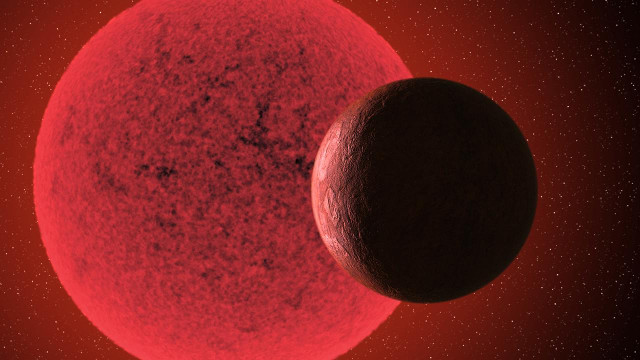
An article accepted for publication in the journal “Publications of the Astronomical Society of Japan” reports the discovery of the exoplanet Ross 508 b, probably a super-Earth at the edge of its star system’s habitable zone. A team of researchers led by Hiroki Harakawa used the IRD (InfraRed Doppler) instrument mounted on the Subaru Telescope to examine the star Ross 508, a red dwarf that has a mass that is only 18% of the Sun’s. The radial velocity method allowed to identify what from the collected data looks like a rocky planet with a mass that is about 4 times the Earth’s. This discovery confirms the value of infrared spectroscopic examinations of red dwarfs.
In recent years, various astronomical investigations focused on red dwarfs, the most common stars in the universe, in search of exoplanets. Most of them are detected when they pass in front of their star from the point of view of a telescope observing it, but the radial velocity method is useful as well. However, the latter may have limitations with red dwarfs due to their dim light, which makes their spectroscopic analysis difficult. A new approach was used to solve this problem.
Hiroki Harakawa’s team exploited the concentration of red dwarf emissions in the infrared electromagnetic band. The Subaru Telescope’s IRD instrument was designed precisely to analyze infrared emissions to search for planets orbiting red dwarfs with the radial velocity method. Ross 508 b was discovered thanks to this approach.
The Ross 508 system is just over 36 light-years from Earth, thus in the cosmic neighborhood. Despite this, observations in visible light hadn’t detected any planets around this red dwarf. The exoplanet Ross 508 b is the first result of the infrared analyzes and it’s interesting also because it’s in its system’s habitable zone, even if at its borders.
The exoplanet Ross 508 b has a year that lasts only a bit less than 11 Earth days but the emissions it receives from its small star are only 40% higher than those that the Earth receives from the Sun. To understand if it really has potential for habitability, it follow-up observations are needed to verify first of all the presence of an atmosphere, and only if the result is positive will it be possible to make evaluations.
Red dwarfs are small stars but they can be very active, especially when they’re young. Ross 508 may have stripped its planet’s atmosphere with repeated superflares, and in this case, it would be a super-Mars. With its mass, it could have maintained an atmosphere that under certain conditions could be very thick, and in this case, it would be a super-Venus. In short, there are various possibilities.
The positive news is that the data collected indicates that from the Earth and its orbit, it’s possible to see the exoplanet Ross 508 b passing in front of its star. This means that instruments such as the TESS space telescope can observe it directly. A precise description of its orbit would allow for in-depth studies. If it had an atmosphere with interesting characteristics, it could become the subject of observations with the James Webb Space Telescope.
