
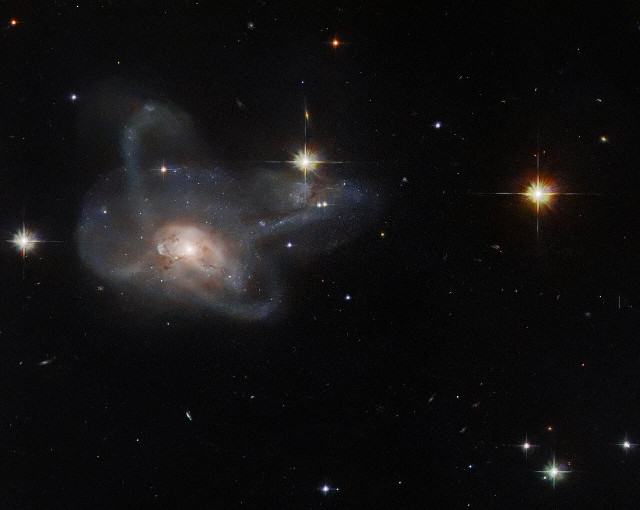
An image captured by the Hubble Space Telescope shows the galaxy CGCG 396-2, out of the ordinary thanks to its many arms. It’s a galaxy that has become an object of interest by the Galaxy Zoo project, one of the astronomical projects that involve the public, in this case, to classify galaxies observed by various telescopes. CGCG 396-2 was selected for follow-up observations with Hubble, whose ACS instrument made it possible to examine the arms that have an unusual configuration because there’s a galaxy merger taking place and consequently an unusual shape that is changing over time.
Astronomical investigations can generate images of thousands of galaxies, sometimes with automatic systems. The result is a scientific treasure trove that, however, can take a very long time to examine and classify all the galaxies discovered. For this reason, projects such as Galaxy Zoo have been activated to allow anyone to participate in astronomical research, in this case, to classify about 900,000 galaxies.
The galaxy CGCG 396-2, also known as LEDA 17532 or 2MASX J05373599+0120038, is approximately 520 million light-years from Earth. It’s one of the galaxies included in the Galaxy Zoo project and that led to it being included in a publicly voted selection of the most intriguing objects for the purpose of conducting follow-up observations with the Hubble Space Telescope. The ACS (Advanced Camera for Surveys) instrument captured the image now published.
Galaxy mergers are normal events in the universe, and astronomers look for the ones caught in the act to study their consequences. The shapes of the merging galaxies are progressively distorted until they reach a new stable shape in a process that can continue for millions of years. Star formation within the new galaxy can be strongly affected if there are gas clouds within it that are compressed during the merger. The mergers between supermassive black holes at the center of galaxies are another object of interest for astronomers even if, for the moment, the available instruments can’t detect the gravitational waves they emit.
The work of citizen scientists participating in projects such as Galaxy Zoo is an aid to subsequent research of professional astronomers. In the case of the galaxy CGCG 396-2, the observations of the various phases of the merger can continue for a very long time and in the meantime, we can see its many arms extending into space.
