
An article published in “The Astrophysical Journal” reports the identification of the star with the closest orbit around Sagittarius A*, the supermassive black hole at the center of the Milky Way. A team of researchers cataloged it as S4716 after finding it in data collected over twenty years with the Keck Observatory, the VLT, and the VLTI. The star S4716 completes an orbit in about 4 Earth years and its distance from Sagittarius A* is as close as 100 times the Earth’s from the Sun. Its discovery, which breaks the record of the star S4711, is surprising and will help to better understand how stars in that area formed and moved, as it’s difficult to think that it formed this close to a supermassive black hole.
Supermassive black holes are perhaps the most extreme objects in the universe, so many astronomers are studying them, and Sagittarius A* is the closest. In addition to their direct study, there are researchers interested in studying the surrounding area to examine their influence and, despite their very powerful gravity, there can be stars in stable orbits around them. In the case of Sagittarius A*, there’s a cluster called the S cluster made up of over one hundred stars orbiting it. It’s not easy to see them because there’s also dust and gas in the area and the star S2 is very bright, so it can obscure the others.
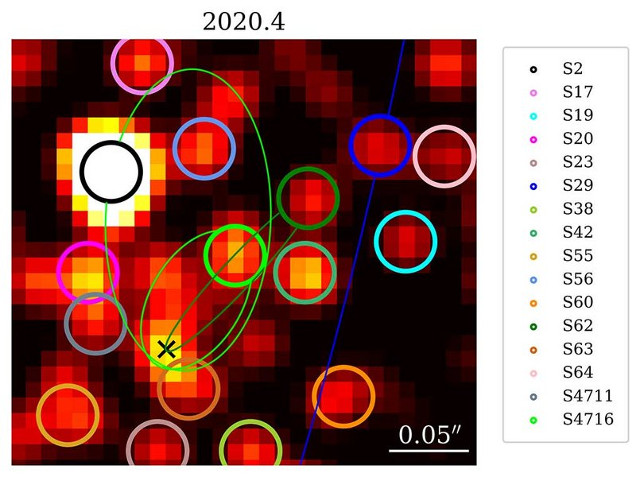
The image (Courtesy Florian Peißker, University of Cologne. All rights reserved) shows 16 of the stars orbiting the supermassive black hole Sagittarius A*, indicated by the cross, observed in 2020 with the OSIRIS instrument at the Keck Observatory. In the center, in light green, is the star S4716 with the ellipse indicating its orbit.
The area around Sagittarius A* has been studied many times over the years using various instruments, so the authors of this new study searched the archives for observations that might be useful. They examined data collected with the NIRC2 and OSIRIS instruments mounted on the Keck Observatory telescopes, with the SINFONI and NACO instruments used in the past with the VLT (Very Large Telescope), and with the GRAVITY instrument mounted on the VLTI (Very Large Telescope Interferometer), which combines the four telescopes of the VLT.
The amount of data put together made it possible to identify the star cataloged as S4716. Its proximity to Sagittarius A* is surprising because the previous record belonged to the star S4711, which orbits the supermassive black hole in about 7.6 Earth years, almost twice as long as S4716. The approximately 4 years taken by S4716 to complete its orbit are a really short period. The star has a minimum distance from Sagittarius A* of about 15 billion kilometers, about 100 times the Earth’s from the Sun. This is a remarkable proximity considering the nature of that object. The orbit is stable because S4716 reaches a speed of approximately 8,000 kilometers per second.
According to the researchers, it’s very difficult for a star to form in the vicinity of a supermassive black hole, where its force of gravity interferes with the coalescence of the gas. Studying the stars in cluster S helps to understand how they could have formed and evolved. In particular, the closest ones such as S4716 almost certainly formed at a greater distance from Sagittarius A* and then approached as a result of gravitational influences, also from other nearby stars. For this reason and to study the interactions between those stars and the supermassive black hole, the studies will continue.
