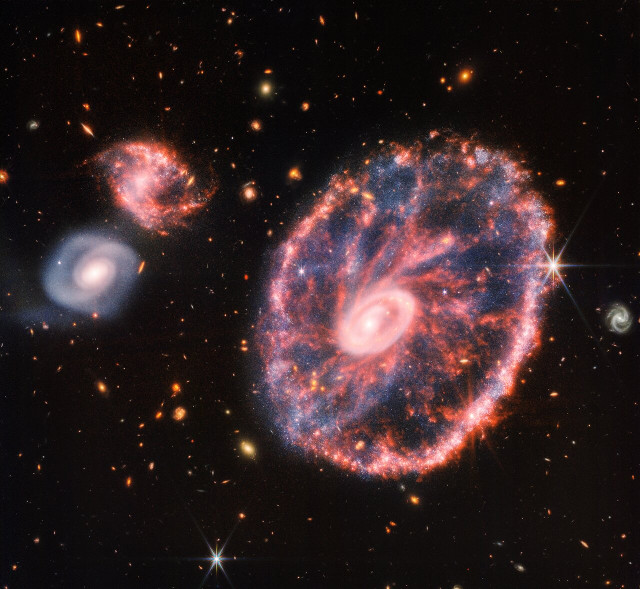
An image captured by the James Webb Space Telescope shows the Cartwheel galaxy in greater detail than those obtained in the past with other telescopes. A combination of Webb’s NIRCam and MIR instruments allowed the identification of individual stars and star-forming regions while also offering new insights into the behavior of the supermassive black hole within this peculiar galaxy. This is a new help in the study of the changes taking place in what is most likely the consequence of a collision between two different galaxies with a transformation still taking place.
Launched on December 25, 2021, the James Webb Space Telescope is already proving to be the extraordinary instrument promised by NASA in its design and construction, which took place in collaboration with ESA and CSA. The discoveries of new objects have just begun and many targets have already been observed before. The Cartwheel galaxy is one such case with an interest from astronomers due to its shape, the result of a complex history.
Reconstructing the history of the Cartwheel galaxy is very interesting for astronomers but at the same time difficult, also because the distance of about 500 million light-years from Earth makes it difficult to observe its details. For this reason, in recent years it was observed with different space telescopes, and archival data were processed with new software that allowed to bring out new details in old images captured by the Hubble Space Telescope. The James Webb Space Telescope is already surpassing all those results.
The two rings whose appearance contributed to the nickname Cartwheel for the galaxy which in the various catalogs is officially referred to as LEDA 2248, ESO 350-40, or IRAS 00352-3359 are still expanding outwards, a very long-term consequence of a collision between two galaxies that occurred a few hundred million years ago.
The entire nucleus of the Cartwheel galaxy contains an enormous amount of hot dust and gas that led to the birth of entire star clusters. Star formation is also common in the outer ring, which collides with the surrounding gas leading to the birth of new stars, often massive and therefore very bright. Those massive stars consume their hydrogen at a very fast rate, so they quickly use it all and end up exploding into supernovae after no more than a few tens of millions of years.
The Near-Infrared Camera (NIRCam) is capable of detecting infrared emissions that pass through clouds of dust and gas. The Mid-Infrared Instrument (MIRI) offers detections at other frequencies of that electromagnetic band with more details and the identification of areas rich in chemical compounds of various kinds including hydrocarbons. This also includes the “spokes” of this galaxy, the other element that led to the nickname Cartwheel. Actually, those are the arms of the spiral that is slowly regaining a regular shape. They were clearly visible in previous observations conducted with the Hubble Space Telescope but Webb offers many more details.
Reconstructing the history of the Cartwheel galaxy and seeing its details is also useful to understand how its transformation will continue in the future. These images captured by the James Webb Space Telescope confirm that this instrument will help make further progress in astronomical studies. In the coming months, scientific articles based on observations conducted with Webb will start being published and, in addition to offering stunning images, will offer new scientific information with answers to questions and probably new surprises.
