
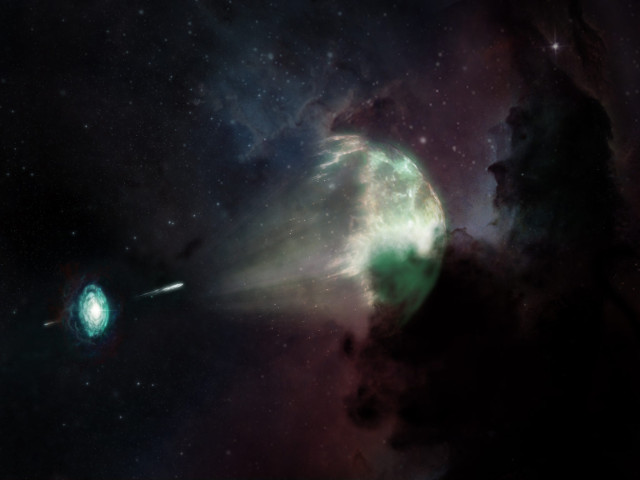
An article accepted for publication in “The Astrophysical Journal Letters” reports the results of the analysis of the detections of the short gamma-ray burst cataloged as GRB 211106A conducted thanks to the ALMA radio telescope. A team of researchers examined the afterglow generated by the interaction with the surrounding gas of the jets that accompany the gamma-ray burst and move at a speed close to the speed of light. This is the first case in which ALMA has been used to examine such an event and other observations were conducted with the VLA and various space telescopes. The resulting dataset covers the various electromagnetic bands and allowed the researchers to conclude that this gamma-ray burst was generated by the merger of two neutron stars.
Short gamma-ray bursts last for a fraction of a second, making them difficult to detect. In the GRB 211106A’s case, it was a specialized instrument that detected it from Earth’s orbit, NASA’s Swift satellite. The first data obtained didn’t allow to identify that short gamma-ray burst’s point of origin and in such cases, the afterglow becomes crucial to obtain the information needed to study them.
Before the ALMA (Atacama Large Millimeter/submillimeter Array) radio telescope was activated in March 2013, it was difficult to examine the afterglow of a short gamma-ray burst even when its emissions were present in the radio band. This is one of the cases where the power and sensitivity of ALMA can make a difference and this was also true in the case of GRB 211106A.
Detections with other instruments sensitive to other electromagnetic bands can add crucial information to obtain a complete portrait of the event. This was true in the past to study a kilonova, as the merger between two neutron stars is called, and again various instruments completed observations of the afterglow of GRB 211106A.
In the case of GRB 211106A, it was the electromagnetic emissions that revealed the merger between two neutron stars but there are no gravitational wave detections since the event dates back to a pause period between the observation campaigns of the LIGO and Virgo detectors. It was one of the shortest and most energetic gamma-ray bursts ever detected, so its emissions can be captured by instruments on Earth and in its orbit even if the source is billions of light-years away.
Observations of the afterglow from GRB 211106A will continue to be analyzed for new information on short gamma-ray bursts and neutron star mergers that generate at least some of them. Now that the James Webb Space Telescope has finally begun its scientific mission, it will also be possible to observe the galaxies in which these events took place in infrared. We know that neutron star mergers generate elements such as gold and platinum, and the spectrographic analysis of emissions could tell us more about these processes as well.
