An article accepted for publication in “The Astrophysical Journal” reports a study on the star R136a1, perhaps the most massive known. A team of researchers pushed the Zorro instrument mounted on the Gemini South telescope to its limits to observe R136a1, or RMC 136a1. The results suggest that it’s less massive than previously estimated, as it was thought to be even more than 300 times the Sun’s mass. It remains a colossus given that the new estimate peaks in probability at 196 times the Sun’s mass. Two “siblings” may also be less massive than previously estimated, as this study estimates the mass of the star R136a2 to be about 151 times the Sun’s and the mass of the star R136a3 to about 155 times the Sun’s. Understanding these huge stars better helps to better predict their end and the chemical elements that will be created at that stage.
The story of the study of the star R136a1 and its siblings begins as far back as 1960 when a strange object was discovered by astronomers who were studying a star cluster in the Large Magellanic Cloud at the Radcliffe Observatory in Pretoria, South Africa. The object was cataloged as RMC 136, or simply R136, and astronomers immediately figured it was a multiple system. Only in 1979, it was possible to resolve some of the stars and the most massive ones attracted attention because they were truly colossal.
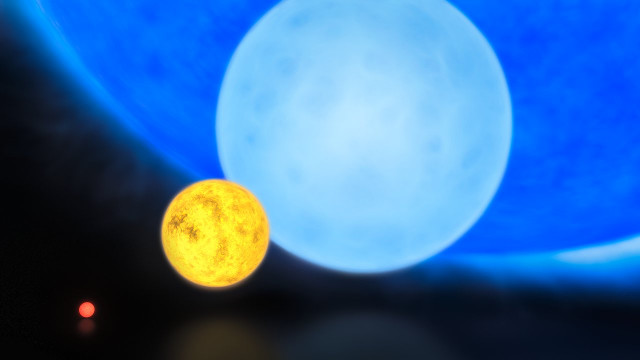
The top image (International Gemini Observatory/NOIRLab/NSF/AURA. Acknowledgment: Image processing: T.A. Rector (University of Alaska Anchorage/NSF’s NOIRLab), M. Zamani (NSF’s NOIRLab) & D. de Martin (NSF’s NOIRLab)) shows at the center the stars R136a1, R136a2 and R136a3 seen by the Zorro instrument in visible light. The bottom image (ESO/M. Kornmesser) shows the relative sizes of various types of stars: a red dwarf, the Sun, a blue B-type star, and R136a1.
At a distance of about 160,000 light-years, it’s not easy to study single stars, even if they’re extremely massive and therefore a few million times brighter than the Sun. R136a1, R136a2, and R136a3 are Wolf-Rayet stars, a class of stars that are very bright, also at ultraviolets, and in particular, are classified in the spectral type WN5h. According to stellar evolution models, they should die in a pair-instability supernova and generate many heavy elements.
Astronomers rely on a star’s brightness and temperature to determine its mass. This requires high-quality observations, a result not easy to achieve with a group of nearby stars in the Large Magellanic Cloud. The Zorro instrument was used to its limits employing a speckle imaging technique to reduce distortions caused by the Earth’s atmosphere. This made it possible to separate the brightness of the individual stars of the cluster R136.
The analysis of the observations indicates that the three colossal WN5h stars are less massive than previously estimated. An estimate based on observations conducted using the Hubble Space Telescope published in May 2016 in the journal “Monthly Notices of the Royal Astronomical Society” indicated that the mass of the star R136a1 was 315 times that of the Sun. The margin of error of these estimates is large, of a few tens of solar masses, so the upper limit of that estimate was 375 solar masses. The 196 solar masses of the new estimate with an upper limit of 240 solar masses are significantly lower.
The differences in the results regarding the stars R136a2 and R136a3 are not that large but they too turn out to be much less massive in this new study. Even considering the upper limits, the estimates for these two stars arrive at “only” 180 solar masses while the probability peaks indicate that the mass of the star R136a2 is about 151 times the Sun’s and the mass of the star R136a3 is about 155 times the Sun’s.
If the validity of the results obtained with the Zorro instrument and of their analysis is confirmed, this means that the predictions regarding the most massive stars known may need to be revised. Their demise may have different results concerning the production of heavy chemical elements, and pair-instability supernovae may be rarer than previously thought because there are fewer stars that are massive enough to explode in a supernova of that type.
This study is based on methods different from the usual ones to determine stellar masses and the authors themselves are cautious about the accuracy of their results. Wolf-Rayet stars eject some of their mass, which adds difficulty in their study with interpretations of data that are based on models that get improved over time. The new information gathered will certainly help the study of extreme stars regardless of the accuracy of the results obtained in the study.