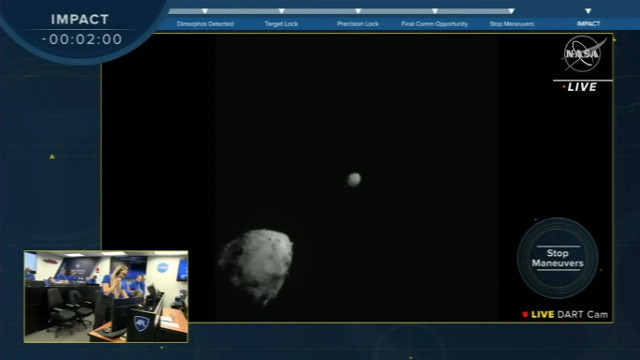
Yesterday, NASA’s DART spacecraft crashed into Dimorphos, a small asteroid satellite of Didymos, a larger asteroid. These two asteroids are visible from Earth using instruments powerful enough, which will be used to monitor Dimorphos’ orbit and how much it was modified by the impact. Nearby is LICIACube, a CubeSat-class mini-probe equipped with two cameras that will provide much better observations than any telescope on Earth.
The DART (Double Asteroid Redirection Test) mission, launched on November 24, 2021, represents the first experiment with the ultimate goal of preparing a defense of the Earth from asteroids that in the future will head towards Earth. Today, we can only hope that they’re not dangerous but the mass extinction that wiped out the dinosaurs precisely because of an asteroid shows how serious the danger can be.
The concept behind the DART mission is that a small change in an asteroid’s trajectory can generate effects that can be remarkable in the long run. Slightly altering the trajectory of an asteroid headed towards Earth when it’s still millions of kilometers away could take it very far from the planet. For this reason, the monitoring of Dimorphos will continue for a long time. The Italian Space Agency’s LICIACube is scheduled to continue its work for about six months.
Monitoring Dimorphos will also offer useful information to understand its structure and composition. Asteroids are considered fossils dating back to the first phase of the solar system’s history, so the data collected will help to better understand how it was formed. There are also asteroid-mining projects, so information on their composition may be useful in the future.
The maneuvering of the DART spacecraft was fully automated. The asteroids Didymos and Dimorphos are relatively close from an astronomical point of view but the radio signals still take many seconds to travel between them and the Earth, so it was impossible to drive it remotely. Testing the automatic guidance system, capable of recognizing its own target and keeping the course towards it, was one of the mission goals and it was fully successful.
In some ways, now the real mission begins. ESA collaborates with NASA and in almost exactly two years, the launch of the Hera mission is scheduled with a space probe sent to Didymos and Dimorphos’ area to examine the consequences of the impact of the DART spacecraft in a close and detailed way. ESA and NASA also work together to improve the monitoring of potentially dangerous asteroids because, in the event of an impact, walls are completely useless while working together, we can find a way to eliminate the danger.