
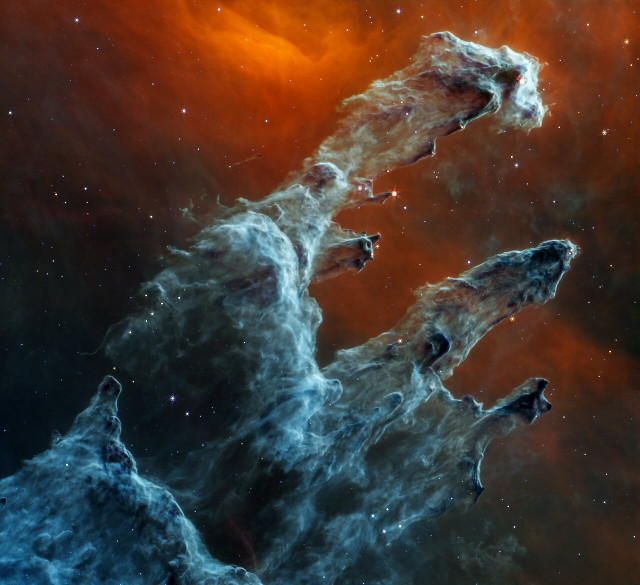
A new image of the so-called Pillars of Creation was released, once again captured by the James Webb Space Telescope. It follows an image published a few days ago yet they show a landscape that looks very different with regards to the background of the structures that gave this star-forming area its nickname. This is due to the fact that this image was captured using the Mid-Infrared Instrument (MIRI), which sees in the mid-infrared, while the previous one was captured using the Near-Infrared Camera (NIRCam), which sees in the near-infrared. The different views offer a combination of information that is very useful in studying the gas and dust clouds in which there are young stars and others in the process of forming.
The large star-forming area within the vast Eagle Nebula made iconic by images from the Hubble Space Telescope continues to be of great interest to astronomical studies. Infrareds are among the frequencies that pass through gas and dust that make up the clouds and form new stars so adequate instruments are needed to study them.
Launched on December 25, 2021, the James Webb Space Telescope is taking infrared astronomy to a new level. That’s because it can detect much more detail than other near-infrared instruments and can detect mid-infrared.
The results of the detections of the different infrared frequencies by the NIRCam and MIRI instruments are very different. Having two instruments that offer such different readings in the same telescope is another strength of the James Webb Space Telescope.
This new mid-infrared view is suitable for Halloween with the columns of gas and dust extending like ghostly fingers against a background that is much darker than the star-filled one seen in near-infrared. The structures are those best seen in the mid-infrared and appear mostly in shades of gray in the new image. The reddish area at the top is where the dust is diffused and colder.
The stars so present in the near-infrared view are almost invisible in the mid-infrared even to an extraordinary telescope like the James Webb because they normally emit too little light at those frequencies. Only the stars still surrounded by a cocoon of dust have enough mid-infrared emissions to be detected and are present at the edges of the columns. Also visible are some blue giant stars that are approaching the end of their life and have already ejected most of their layers of gas and dust.
Formations such as the Pillars of Creation show that even gas and dust can offer breathtaking shows. For astronomers, the combination of the detections obtained at different infrared frequencies thanks to the NIRCam and MIRI instruments offer a much more precise mapping of that area. The goal is always to improve the models regarding star formation.
