
An article published in the journal “Nature” reports a study on the blazar Markarian 501, or simply MRK 501, which offers an explanation for the jets of particles emitted at speeds close to the speed of light. A team of researchers used NASA’s IXPE space telescope to study Markarian 501 and concluded that shock waves within the jets were the most likely explanation.
Markarian 501 is a blazar, a type of active galactic nucleus that emits powerful jets of particles at speeds approaching the speed of light. When one of its jets is aimed at Earth, this type of object is called a blazar. These objects are powered by supermassive black holes surrounded by disks of materials.
Launched on December 9, 2021, the IXPE (Imaging X-ray Polarimetry Explorer) space telescope of NASA and the Italian Space Agency can offer unique information on the polarization of light emitted by X-ray sources among which there are blazars. It’s information about the direction in which the magnetic field associated with polarized light oscillates.
In the case of Markarian 501, IXPE offered the possibility of mapping the magnetic field within which the jet particles are accelerated and emit X-rays. The researchers added other observations conducted in March 2022 like those of IXPE but with other telescopes sensitive to other bands of the electromagnetic spectrum. This made it possible to establish that X-ray emissions are more polarized than optical ones, which in turn are more polarized than radio ones.
The researchers used the data obtained to test theoretical models regarding the possible causes of particle acceleration. The model that most closely matches the data is the one in which a shock wave accelerates the particles. The origin could be in some disturbance in the jet stream which causes a section of it to become supersonic. The disturbance could be generated by collisions of energetic particles or by pressure changes at the jet boundaries.
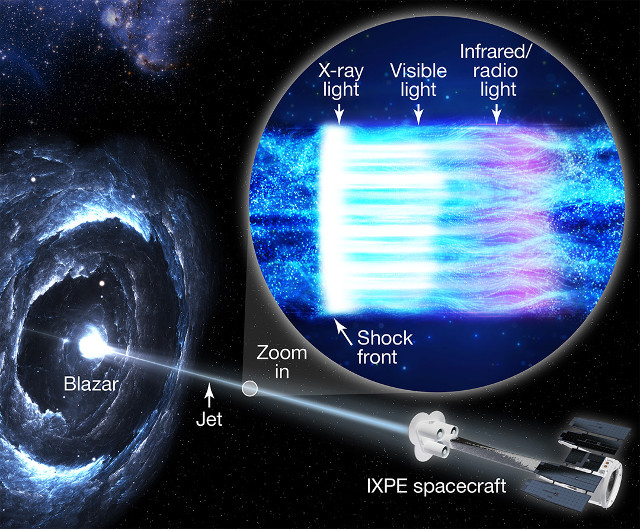
When the jet moves beyond the shock wave’s place of origin, the particles that compose it pass through regions where there are turbulent magnetic fields. This reduces the polarization in a way that depends on the energy emitted by the particles and explains the differences found in the different electromagnetic bands.
The image (NASA/Pablo Garcia) shows the scheme of the observation of the blazar Markarian 501 with the IXPE space telescope. The circle shows the details of the energetic particles present in the jet directed towards the Earth and their electromagnetic emissions with their origin, their movement, and the reduction of their polarization.
The observations of the blazar Markarian 501 will continue to obtain more details of the ongoing processes and see if the polarization changes over time. The IXPE space telescope will also be used to study other blazars to understand if the processes taking place in their jets are the same. These are studies that will help to better understand the processes related to supermassive black holes.
