
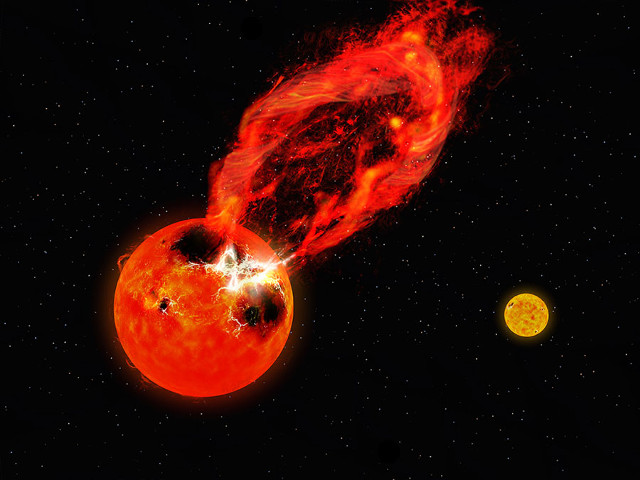
An article published in “The Astrophysical Journal” reports the detection of a superflare in the V1355 Orionis system, a pair of stars of the variable RS Canum Venaticorum type, which features a more massive and evolved star than its companion. A team of researchers used space and ground-based telescopes to monitor the activity of the V1355 Orionis system, known for its powerful eruptions. This allowed to obtain continuous observations of this phenomenon, which was generated by a process called prominence eruption. This study offers new insights into these stellar phenomena that also occur on the Sun, albeit with a much smaller force.
Also known as HD 291095, the V1355 Orionis system consists of two stars, one of which is a subgiant, brighter than normal main-sequence stars but not as bright as true giant stars. About 400 light-years from Earth, it’s been the subject of various studies, also because it’s known for its powerful stellar eruptions.
The authors of this new study used observations of the V1355 Orionis system conducted with the KOOLS-IFU spectrograph mounted on the 3.8-meter Seimei telescope in Japan and with NASA’s TESS space telescope over the course of 27 days to monitor a superflare originating in the subgiant star.
On the Sun, flares are explosive phenomena in which magnetic energy stored around sunspots is suddenly released in what is technically called a coronal mass ejection. In a pair of stars of the variable type RS Canum Venaticorum, the most massive star has very large sunspots which can give rise to flares many times more powerful than solar flares.
On the Sun, prominence eruptions are associated with flares because they can lead to a coronal mass ejection when the prominence velocity is sufficient. In the V1355 Orionis system, the phenomenon has a much greater scale and the one observed in this study is one of the most massive ever observed with a flow rate of trillions of tons of plasma ejected at a remarkable speed.
This study offers information on processes that are not easy to examine due to the great brightness of the stars on which they occur. This specific case indicates how large a prominence eruption can be and a system like V1355 Orionis will certainly feature new superflares that will provide more information to broaden the investigation.
No exoplanets have been identified in the V1355 Orionis system but if there were any, they would be struck by an amount of radiation sufficient to wipe out any possible atmosphere. From this point of view, the Sun is far quieter but it’s certainly useful to understand the processes behind flares that can still create problems for everything in orbit and even for electrical grids on the ground.
