An article published in the journal “Nature” reports the results of an examination of the exoplanet WASP-18b. A team of researchers used the James Webb Space Telescope to map the temperatures on the surface of this ultra-hot Jupiter very close to its star. The temperature variations are around 1,000° Kelvin between the hottest area always facing its star and the border area between day and night. Webb’s Near-Infrared Imager and Slitless Spectrograph (NIRISS) also found traces of water vapor that other instruments had missed.
Just over 400 light-years from Earth, the star WASP-18 is a little bigger and more massive than the Sun. In 2009 came the announcement of the discovery of a planet so close to it that its year lasts less than an Earth day. WASP-18b has a mass estimated at about ten times Jupiter’s, another reason for interest in this planet, as it approaches the boundaries between the planet and the brown dwarf.
Over the years, the exoplanet WASP-18b has been studied on various occasions with different instruments. One purpose was to assess its orbit’s decay and estimate how much time is left before it’s swallowed by its star.
Due to its proximity to its star, the exoplanet WASP-18b is tidally locked, always showing the same face, just like the Moon with the Earth. On its day side, the temperature reaches 3,000° Kelvin but it took the James Webb Space Telescope’s sensitivity to be able to map the temperature changes. This is the first mapping of its kind, a type of study useful to test models for planets of the hot and ultra-hot Jupiter class.
The temperature difference between the hottest area of the exoplanet WASP-18b and the edge of its day side is about 1,000° Kelvin. This indicates that the heat is not distributed very well on its surface but the reason hasn’t yet been clarified.
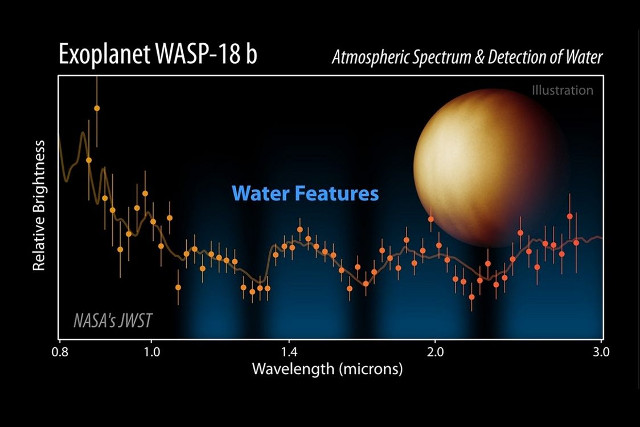
The spectrographic examination also made it possible to map the composition of the atmosphere of the exoplanet WASP-18b. The temperature on its day side is so high that it breaks water molecules apart yet the James Webb Space Telescope discovered traces of water vapor. This was a surprising finding, also because other instruments hadn’t detected water vapor leading to believe that all the water was eliminated by the intense heat.
The image (NASA/JPL-Caltech/R. Hurt) shows an artist’s impression of the exoplanet WASP-18b and the spectrum of thermal emissions detected by the James Webb Space Telescope’s NIRISS instrument at wavelengths between 0.85 and 2.8 microns.
The composition of the exoplanet WASP-18b is very similar to that of its star, which means that it most likely formed from the gas left shortly after its formation. These results are useful to try to understand the formation of planets that are very different from the ones existing in the solar system. In this case, it’s an interesting planet from various points of view that will continue to be monitored to follow its fate.
