
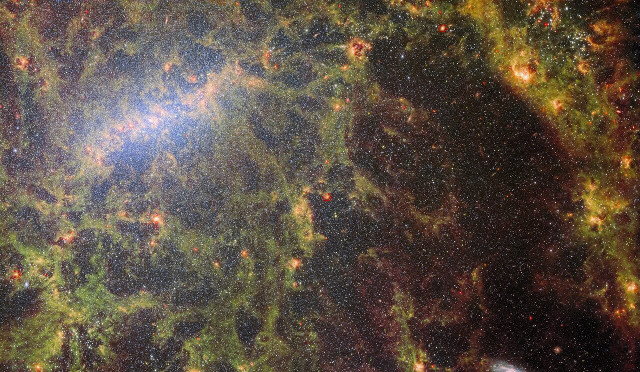
An image captured by the James Webb Space Telescope shows the core and part of a spiral arm of the galaxy NGC 5068. Two instruments, MIRI and NIRCam, were used to examine this barred spiral galaxy, and the various infrared filters allowed to detect an enormous amount of detail among dusty structures and star-forming areas where there are newborn stars still surrounded by shells of gas and dust.
About 20 million light-years from Earth, the galaxy NGC 5068 belongs to the most common class in the universe, spiral galaxies. The presence of a star formation extending from the core in a shape resembling a bar places it in the subclass of the barred spiral galaxies, which probably make up about two-thirds of their class.
Star formation processes are among the most studied by astronomers and relatively close galaxies such as NGC 5068 offer many possibilities to observe them. For this reason, these observations conducted with the James Webb Space Telescope were part of a campaign to create a survey focused on star formation in nearby galaxies. These are galaxies already studied with various instruments over the years and astronomers hope that Webb will allow them to make progress in understanding these processes.
The main problem in the observations of protostars and newborn stars is that they’re surrounded by large quantities of gas and dust which block most of the electromagnetic emissions. Infrared is among the emissions that pass through the cocoons surrounding those stars and protostars and the clouds in which they are born. The James Webb Space Telescope was designed to detect infrared better than existing instruments and is already helping in the study of star formation.
In the PHANGS-JWST observation campaign, the first results of which were presented in recent months, the MIRI (Mid-InfraRed Instrument) and NIRCam (Near-InfraRed Camera) instruments were used in combination to offer the best results. This image of the galaxy NGC 5068 shows its core with the bar in the upper left and a spiral arm. MIRI made it possible to highlight above all the dusty structures with the shells surrounding protostars and newborn stars. NIRCam made it possible to observe in particular the many stars of NGC 5068 and the reddish clouds illuminated by those stars.
The image of the galaxy NGC 5068 is spectacular and it’s no coincidence that ESA chose it as the James Webb Space Telescope’s image of the month and NASA administrator Bill Nelson showed it at a meeting with students at the Copernicus Science Centre in Warsaw, Poland. Webb is reminding us of the beauty of the universe with its pictures and helping astronomers discover its secrets. The information collected is combined with that already present in the archives of other telescopes such as Hubble, VLT, and ALMA, embracing as many bands as possible of the electromagnetic spectrum and obtaining important details on star formation.
