
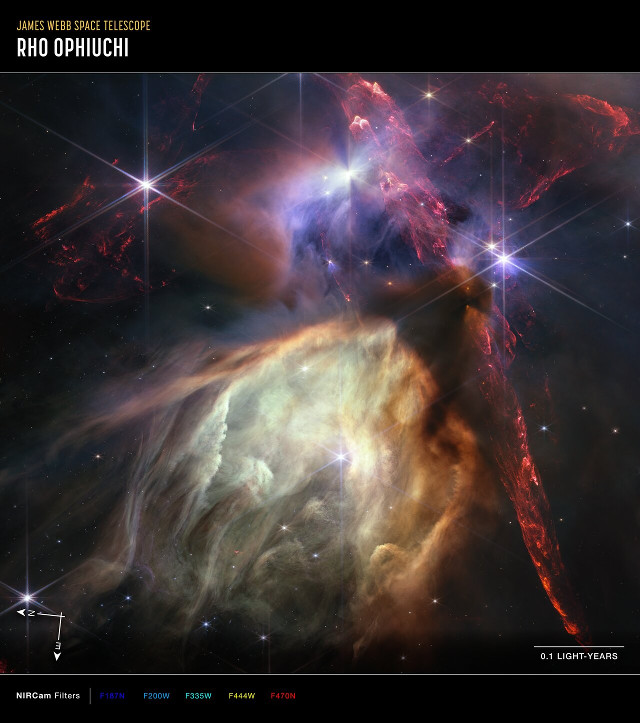
An image (NASA, ESA, CSA, STScI, K. Pontoppidan (STScI), A. Pagan (STScI)) of part of the Rho Ophiuchi complex captured by the James Webb Space Telescope was chosen to mark the first anniversary of the release of the first official images in astronomy’s new flagship instrument’s science mission. The NIRCam instrument captured details of this giant molecular cloud that forms one of the closest star-forming regions to Earth. Delays and various problems had led to postpone many time Webb’s launch date but in the last year, all the promises of progress in the field of astronomy have been kept and this is only the beginning.
About 400 light-years away from Earth, the Rho Ophiuchi molecular cloud has already been the subject of many studies related to star formation processes. That region includes about 50 young low- to medium-mass stars. The presence of young Sun-like stars and traces of protoplanetary disks could offer insight into the early history of the solar system.
In the image captured by the James Webb Space Telescope, the dark areas are the densest, where protostars form in cocoons of gas and dust. Intense jets of molecular hydrogen are visible in red and appear horizontally along the upper third and vertically to the right. Those jets indicate stars that break through their cocoons and emit a pair of jets in opposite directions. The star classified as S1, the only one significantly more massive than the Sun, carved a bright cavity in the dust, visible at the bottom of the image. The lighter colors around S1 are generated by polycyclic aromatic hydrocarbons, compounds that are very common in space.
The James Webb Space Telescope’s ability to detect infrared emissions, among the very few electromagnetic emissions that pass through dust, is invaluable in the study of star nurseries such as Rho Ophiuchi. Different filters were used in the observation of this cloud obtaining results that were converted into hues visible to the human eye obtaining yet another breathtaking image which at the same time is very useful to astronomers.
The image of the Rho Ophiuchi complex demonstrates the potential of the James Webb Space Telescope in every way. Studies conducted during the first year of its scientific mission are still being processed and will be published in the coming months. Meanwhile, observations continue on many cosmic phenomena to reveal other secrets.
