
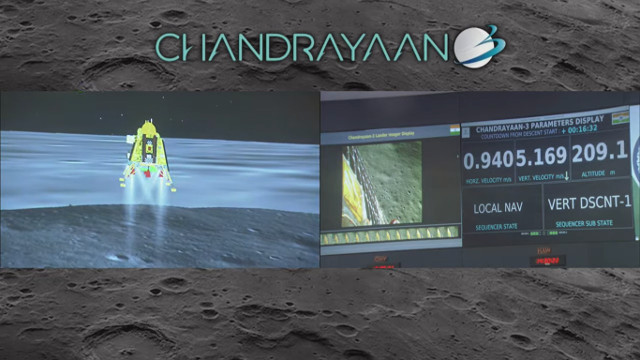
The Vikram lander and the Pragyan rover of the Indian mission Chandrayaan 3, launched on July 14, have successfully landed on the Moon. The idea at the Indian space agency ISRO was to replicate what was done almost exactly four years ago in the Chandrayaan 2 mission, eliminating the problems encountered on that occasion in order to achieve success. The hard lesson was learned and this time, the vehicles successfully completed the insidious maneuver of landing on the Moon. India joins the small club of nations that successfully sent a vehicle to the Moon.
The attempted landing on the Moon represented the final phase of a long series of maneuvers which on August 5 brought the vehicles into the Moon’s orbit. In the last phase of the maneuvers, there was the separation of the Vikram lander and the Pragyan rover from the propulsion module that was necessary to provide the systems the vehicles needed to arrive in the lunar landing area without making the lander too heavy.
After landing near the Moon’s south pole, the small Pragyan rover will quickly separate from the Vikram lander as they have a limited operating time of one Moon day, or about 14 Earth days, to conduct their detections. The rover has the task of exploring the area, collecting minerals to examine with its instruments, and making observations of the area.
In recent years, China has been the most successful nation in Moon missions, making the success of the Chandrayaan 3 mission all the more important for India given the existing rivalry between the two countries. The importance of this success was further stressed by the presence of Indian Prime Minister Narendra Modi in remote connection and by his speech after the Moon landing, in which he nevertheless mentioned the global importance of this success and collaboration between nations.
An understandable enthusiasm erupted at the mission control center after the Moon landing. The failures of various nations’ missions in recent years show how difficult it is still to carry out an automated Moon landing. For India, it’s truly a great success, also because it’s the first nation to have obtained it in an area close to the Moon’s south pole.
