
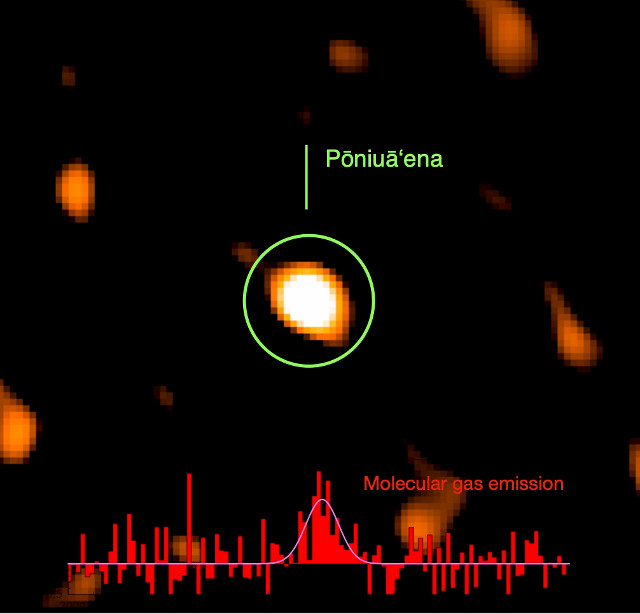
An article published in “The Astrophysical Journal Letters” reports the discovery of the most distant cold molecular gas in the interstellar medium of the galaxy that hosts the quasar nicknamed Pōniuāʻena, one of the three most distant bright quasars known. A team of researchers led by some associates of the Italian National Institute of Astrophysics (INAF) used observations conducted with the NOEMA (Northern Extended Millimeter Array) radio telescope to obtain the detection of the gas, to be precise carbon monoxide. This study can provide valuable information to understand how a supermassive black hole could have a mass 1.5 billion times the Sun’s when the universe was “only” 700 million years old.
The top image (IRAM/NOEMA/C. Feruglio (INAF)) shows the quasar Pōniuāʻena seen by the NOEMA radio telescope and at the bottom, the spectroscopic map with the peak in emissions with the “chemical signature” of carbon monoxide.
The mechanisms of supermassive black hole formation are not yet well understood, especially of the primordial ones, which formed relatively quickly. Observations that have the quality necessary to collect the data needed to test various models are complex due to the distance of these black holes. Help comes when they are surrounded by gas and dust that are heated to the point of generating very powerful electromagnetic emissions in what are called quasars, the brightest objects in the universe.
The quasar Pōniuāʻena has a Hawaiian-language nickname because it was discovered and initially studied by observatories in Hawaii. It’s one of the three most distant bright quasars known and has now been studied with the NOEMA radio telescope, made up of 12 antennas in the French Alps. It’s the most powerful radio telescope operating at millimeter wavelengths in the Northern Hemisphere. NOEMA allowed to obtain unprecedented results in this type of study, allowing to obtain detections not only of dust but also of cold gas.
Molecular clouds of hydrogen form star nurseries when the gas is cold enough. It’s not possible to directly detect hydrogen in clouds but the ratio between the amount of hydrogen and carbon monoxide is known empirically and carbon monoxide is detectable. For this reason, the detection of that gas in the interstellar medium of the galaxy hosting the quasar Pōniuāʻena, the first in such an ancient galaxy, is important. So far, estimates on the quantity of hydrogen and the formation of molecules were possible by observing galaxies that formed at a later time, about a billion years after the Big Bang.
The presence of large amounts of gas is also important to understand the growth possibilities of primordial supermassive black holes. The observations conducted with the NOEMA radio telescope agree with the models and simulations regarding the formation of cold gas at the time of the quasar Pōniuāʻena and this is important to understand how the supermassive black hole that powers it reached a mass of about 1.5 billion times the Sun’s when the universe was still young. The presence of a large amount of gas that gets quickly devoured could be one explanation.
The quasar Pōniuāʻena is part of HYPERION, a sample of bright primordial quasars selected because they turn out to gobble up materials to an extreme extent. Studies of these quasars will also offer information on the influence of the supermassive black holes that power them on the evolution of their host galaxies. This is another object of study that is showing how star formation can be stimulated or inhibited by those supermassive black holes depending on some conditions at the center of research.

