
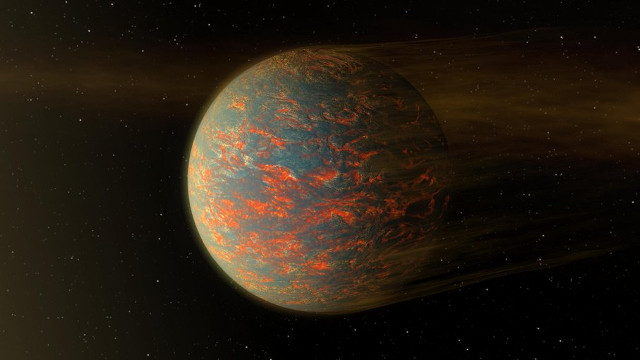
An article published in “The Astrophysical Journal” reports a study on so-called lava worlds, rocky exoplanets so close to their stars that at least a part of their surface is made up of molten rock. A team of researchers coordinated by the Ohio State University conducted computer simulations with the free / open source software ExoPlex to try to understand the evolution of these truly exotic planets, concluding that in certain cases, it’s possible that significant quantities of chemicals necessary for life remain trapped in their mantle. It remains unlikely, to say the least, that life forms could develop in those conditions, but if a planet of that type were to cool, the situation would change considerably. In any case, it’s important to understand its evolution because there may be many lava worlds that offer the possibility of studying a molten planetary mantle.
Lava worlds have also been nicknamed fizzy super-Earths because the magma oceans that occupy their surfaces are full of volatile gases. These planets are tidally locked with their stars, to which they always show the same face. This means that the temperature difference between the day and night sides can be remarkable and that the mantle is only molten on the day side but what conditions determine the diffusion of magma?
ExoPlex is a software developed for the purpose of modeling the internal structure of exoplanets and is available for Linux and Mac OS platforms under the free/open source license GPL3. In this study, it was used to simulate possible conditions on super-Earths very close to their stars. Different chemical conditions were considered, starting with the presence or absence of water, but also the presence of carbon compounds, in particular carbon dioxide. The range of surface temperatures considered is from 1,200° to 2,200° Celsius.
The conclusions of the simulations are that there are different ways in which a lava world can cool leading to the solidification of the mantle. This depends on the composition of the magma and the presence of an atmosphere. Among the various possibilities, there’s also that significant quantities of water and volatile substances such as chemical compounds crucial for life remain trapped in the mantle.
The models created by the simulations indicate that the mantle of a lava world can be of three types: the first in which the mantle is completely molten, the second in which there’s a magma ocean on the surface of solid rock and the third in which there’s a situation likened to a sandwich with a magma ocean on a layer of solid rock in the middle and another layer of magma below, closer to the planetary core.
The possibility of trapping chemical compounds in the mantle is interesting even if lava worlds close to their stars will never develop conditions close to those of Earth. One wonders whether these are conditions also present on newborn rocky planets like primordial Earth. Studies on lava worlds are just beginning, as we still know very few of them, so information about them will increase over time and simulations will improve. Worlds that may seem like a scientific curiosity could turn out to be interesting in unexpected ways.
