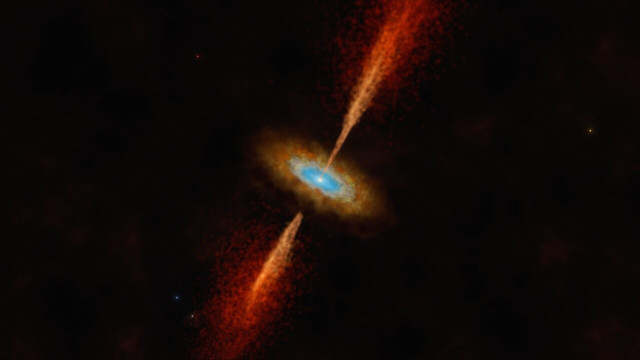
An article published in the journal “Nature” reports the identification of a protoplanetary disk around the very young star cataloged as HH 1177 in the Large Magellanic Cloud, one of the dwarf galaxies satellite of the Milky Way. A team of researchers used the ALMA radio telescope to observe the disk in a follow-up study after observations conducted with the MUSE instrument mounted on the VLT allowed to see jets coming from the still-forming star. This is the first detection of a circumstellar disk in another galaxy. That type of structure is also called a Keplerian disk in jargon because it obeys the same laws as planetary motion.
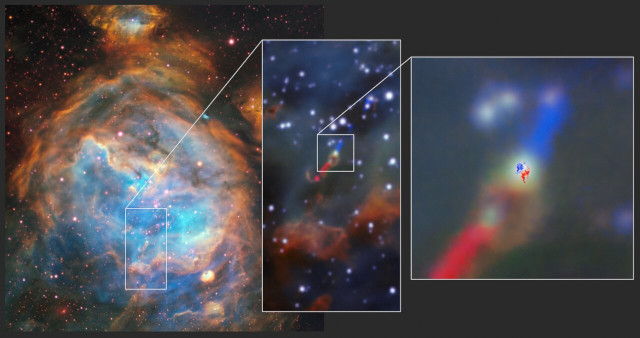
The top image (ESO/ALMA (ESO/NAOJ/NRAO)/A. McLeod et al.) shows on the left, the star-forming cloud cataloged as LHA 120-N 180B in the Large Magellanic Cloud, in the center, the HH 1177 system seen by the MUSE instrument with the jets accompanying it, and on the right, HH 1177 seen by ALMA. The movements of the materials cause a shift of the light frequencies towards the blue on the top side and towards the red at the bottom due to the Doppler effect.
The Large Magellanic Cloud is a dwarf galaxy about 160,000 light-years from the Milky Way and has a mass that is about one-tenth of the Milky Way’s. Thanks to its relative proximity, astronomers can observe stars within it, but identifying a circumstellar disk in which new planets could form was so far impossible.
The system classified as HH 1177 has been known for some years thanks to the MUSE (Multi Unit Spectroscopic Explorer) instrument mounted on ESO’s VLT (Very Large Telescope) in Chile. In a region of star formation, jets were detected coming from what is defined as a young stellar object, a star still in the process of formation, in this case, a massive one with a mass estimated to be around 12 times the Sun’s. In that phase, jets of materials of that type are associated with a circumstellar disk which, however, still had to be observed.
In circumstellar disks, gravitational balance is maintained due to the fact that materials closer to the star or protostar rotate faster than materials further away. That was exploited by researchers to locate that disk using the ALMA (Atacama Large Millimeter/submillimeter Array) radio telescope. The observations conducted with ALMA allowed detailed measurements of the frequencies of the light arriving from the HH 1177 system to be obtained. The Doppler effect altered those frequencies, allowing the materials’ movement direction and velocity around the star to be measured.
Despite the distance of the HH 1177 system, which is far greater than that of any system within the Milky Way, studying a system in the Large Magellanic Cloud offers some advantages. The study of massive stars in the Milky Way is hindered by large amounts of dust surrounding them precisely during the phase in which a circumstellar disk exists. The HH 1177 system is forming in a much less dusty environment, so it’s not wrapped in a cocoon of gas and dust, and observations are not hindered.
Professor Anna McLeod of the British Durham University, the lead author of this study, stressed the excitement about the possibility of studying stars at intergalactic distances offered by the rapid technological advances of astronomical installations in this era. In this case, it’s the first circumstellar disk observed in another galaxy.
The star HH 1177 will have a short life in astronomical terms because its considerable mass will lead to a very quick consumption of its hydrogen. This means that planets could form in the disk surrounding it but even if one of them weren’t heated too much to have a stable atmosphere and conditions favorable to life, within a few tens of millions of years, it would be hit by the star’s explosion in a supernova. However, it’s still a very interesting system from a scientific point of view for observing its formation processes.