
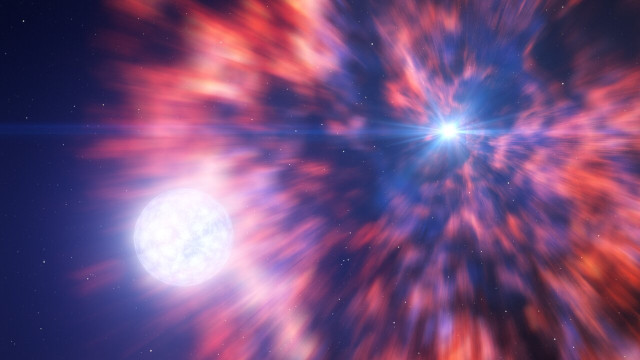
Two articles, one (link to the file in PDF format) published in the journal “Nature” and one in “The Astrophysical Journal Letters”, report different aspects of a study of the supernova remnant cataloged as SN 2022jli which include evidence of the presence of a compact object that could be a neutron star or a black hole that formed after the supernova. Two teams of researchers used various instruments including the Very Large Telescope (VLT) and the New Technology Telescope (NTT), both ESO’s, to study the consequences of this supernova and find the direct link to the formation of a compact object.
Astronomers have long established that a massive star ends its life by exploding in a supernova and the remaining core collapses, forming, depending on the mass still existing, a neutron star or a black hole. However, the process was never observed, at least until now.
Supernova SN 2022jli occurred in the galaxy NGC 157, about 75 million light-years from Earth. Discovered in May 2022 by the South African amateur astronomer Berto Monard, it quickly became an object of study and two teams studied its consequences, which turned out to be peculiar and for this reason very interesting.
After the intense brightness of a supernova, its light gradually and continuously fades over time. Instead, SN 2022jli showed an oscillation in brightness with a period of about 12.5 days. Both teams, led respectively by Ping Chen of the Weizmann Institute of Science, Israel, and Thomas Moore of Queen’s University Belfast, Northern Ireland, think that this phenomenon is due to the presence of another star that survived its companion’s explosion.
According to the most likely reconstruction, the compact object that formed after the supernova and the normal star continued to orbit each other in a binary system. However, the normal star’s atmosphere interacted with the materials ejected by the supernova, resulting in its atmosphere swelling to the point that the compact object completes part of its orbit within its companion’s atmosphere. In that phase, the compact object steals gas from its companion and this generates energy and electromagnetic emissions that determine the oscillation of its brightness. This process is illustrated in the bottom image (ESO/L. Calçada).
Both a neutron star and a black hole can cause that type of effect but neither team could establish with certainty the nature of the object that formed after the supernova SN 2022jli. New observations will show the evolution of that situation and will also help understand the future of this binary system.
One possible scenario is the formation of a Thorne-Żytkow object, formed by a red giant or supergiant or a massive Wolf-Rayet star containing a neutron star within it. It would be the first object of this type observed since so far, it was only hypothesized. Observations of the binary system will be able to ascertain if the two companions are getting closer and in the future, there could be a merger which would be extremely interesting for astronomers.
In general, the study of the consequences of supernovae is interesting for astronomers, so the study of SN 2022jli will continue in the coming years, also with the new telescopes that will come into service. The elements generated in the progenitor star during its life and death ejected into interstellar space could contribute to the formation of new star systems. In this case, however, there’s a binary system and astronomers are also interested in studying the consequences on the companion and its influence on the supernova remnant.

