
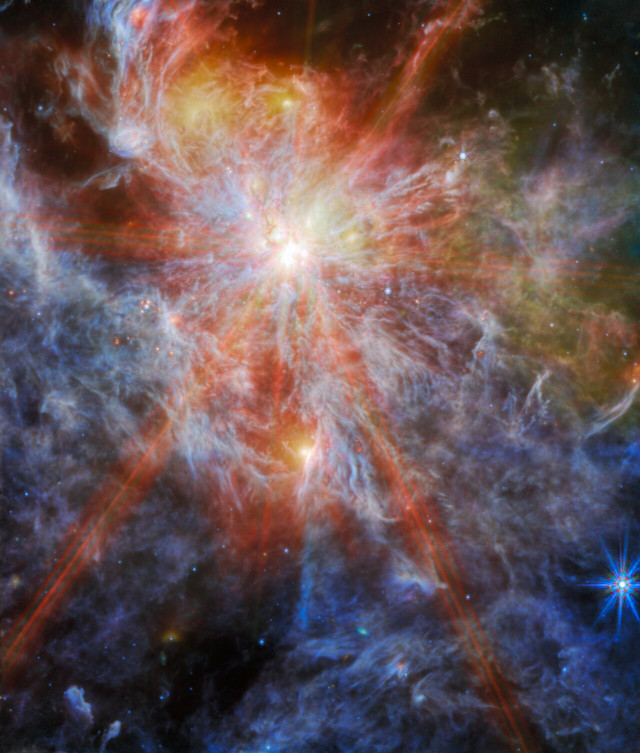
An image captured by the James Webb Space Telescope shows a part of the star-forming region cataloged as N79 in the Large Magellanic Cloud, one of the Milky Way’s satellite dwarf galaxies. It’s considered a sort of younger version of the Tarantula Nebula but astronomers believe that its star formation has been twice as efficient over the last 500,000 years. The Mid-InfraRed Instrument (MIRI) was used to capture never-before-seen mid-infrared details of N79 that will be invaluable in improving our understanding of star formation processes.
The image shows one of the three giant molecular complexes, called N79 South or simply S1. These large molecular clouds are star nurseries where entire star clusters form in an area about 1,630 light-years across. The significant amount of dust makes observations difficult because most electromagnetic emissions are blocked. Infrareds are among the few emissions that pass through those clouds and it’s for this reason that the James Webb Space Telescope allows unprecedented observations.
Even the James Webb Space Telescope is imperfect, and that’s evident in the light rays that appear to be emitted from the bright young star near the center of the image. Actually, these are what in technical jargon are called diffraction spikes, effects generated when light curves around a telescope’s sharp edges. Webb’s mirror is divided into hexagonal segments with three struts in a system designed to limit the problem, but observations of compact light sources such as a very bright star generate that kind of effect.
The images captured by the James Webb Space Telescope are nevertheless extraordinary and, in the case of this molecular complex, offer never-before-seen opportunities to observe star formation in an area with a chemical composition similar to that commonly present when the universe was a few billion years old. Star-formation areas in the Milky Way have different chemical compositions and this also offers the possibility of comparing star-formation processes under different conditions.
The many colors that contribute to making the image spectacular are the result of the combination of different filters applied to four infrared frequencies. This also allows to detect the chemical traces left strongly in the electromagnetic emissions by some compounds already present in that molecular complex such as polycyclic aromatic hydrocarbons (PAHs) and silicates.
One hope in studying the N79 South molecular complex with the James Webb Space Telescope is to be able to identify circumstellar disks around stars that are still forming. A few months ago, the announcement came of the success of this type of discovery using the ALMA radio telescope, another of the most powerful and sensitive astronomical instruments in existence. Being able to study other disks in which there could be planets forming in the Large Magellanic Cloud would constitute a further step forward for astronomy.
