
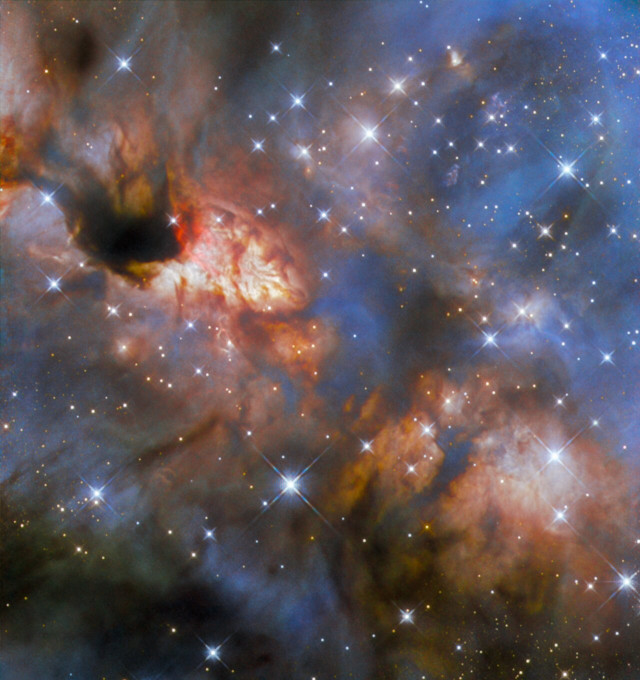
An image captured by the Hubble Space Telescope shows a part of the star-forming area cataloged as IRAS 16562–3959. The Wide Field Camera 3 (WFC3) instrument offers many details of that area at infrareds, in particular of the emissions coming from a massive star still in its formation phase whose consequences are visible in the part of the image that goes from the center towards the upper left and lower right. These and many other details can help reconstruct star formation processes.
About 5,900 light-years away from Earth, the IRAS 16562–3959 area is very dynamic with ongoing chaotic processes that are leading to the birth of new stars. The Hubble Space Telescope can detect near-infrared, which is very useful to see inside dust-filled clouds that block many electromagnetic frequencies. Some areas of the image are more or less dark precisely because the amount of dust is such that it obscures them even from Hubble.
The nebula in which new stars are being born is mainly made up of hydrogen but there are also other elements produced by previous generations of stars and complex molecules have formed over time. Their research constitutes one of the fields of study linked to that of protostars and the clouds that surround them to understand which molecules can form in space and can “sow” new planets.
An article published in July 2020 in “The Astrophysical Journal” reported the detection of organic molecules in the vicinity of one of the protostars forming in the IRAS 16562–3959 area. Among the molecules that left their chemical signatures in the electromagnetic emissions picked up by the ALMA radio telescope are methanol and acetone.
The most massive protostar in that area, at the center of the image, has a mass estimated to be around 30 times that of the Sun and hasn’t completed its formation. It will consume its hydrogen at such a pace that it will only live for a few million years, so any planets that might form around it will not have enough time to have conditions favorable to the development of life forms. Perhaps, other protostars will have a mass closer to the Sun’s, and the organic molecules that have already formed will be able to sow their planets.
The consequences of the formation processes of the most massive protostar are visible in the part of the image that goes from the center towards the upper left and the lower right, where two powerful jets are emitted from its poles and sweep away the dust. In contrast, the central part of the image is darker because there’s a much higher concentration of dust that prevents even the Hubble Space Telescope from seeing beyond it.
This multi-colored image was created using four filters in four different near-infrared wavelengths for the Hubble Space Telescope’s WFC3 instrument. The aim is to capture different details to be combined to obtain new information on star formation processes, in this case, in particular, of a very massive star.
