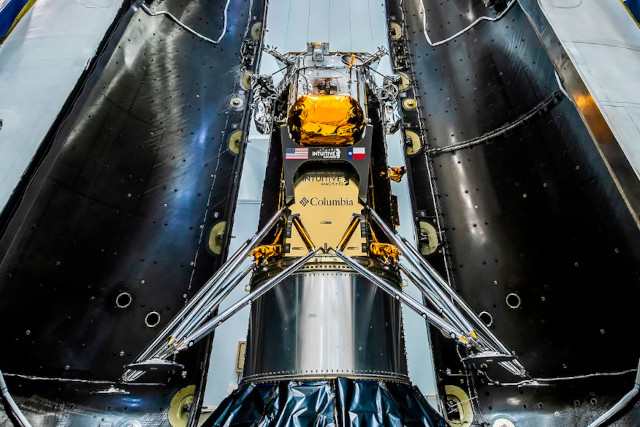
A few hours ago, the Nova-C Odysseus Moon lander blasted off atop a SpaceX Falcon 9 rocket from the Kennedy Space Center on Intuitive Machines’ IM-1 mission. After about 48 minutes, it successfully separated from the rocket’s last stage and set off on a course that will take it to the Moon, where a Moon landing attempt is scheduled on February 22.
Nova-C is a relatively small lander 4.3 meters tall and 1.6 meters in diameter weighing 675 kilograms. In its press kit, Intuitive Machines compared its size to the Tardis, although obviously, the lander is not bigger on the inside than on the outside. 😉
The Nova-C project is an evolution of NASA’s Morpheus project. The propulsion system is based on methane and liquid oxygen and is capable of taking off and landing vertically with obstacle-sensing technology for a safer landing. NASA developed it in the last decade’s early years and later the various technologies were taken up by Intuitive Machines, an aerospace company founded in 2013.
The IM-1 mission of the Nova-C lander that was named Odysseus aims to become the first private mission to achieve a successful Moon landing. This is one of at least three Moon missions planned for as many Nova-C landers in a contract with NASA within the Commercial Lunar Payload Services (CLPS) program. For this reason, Odysseus transports six instruments on behalf of NASA and six from other private companies.
The Nova-C Odysseus lander’s journey will be short compared to other landers, as it will last less than a week. Once it reaches Moon orbit, it will take about another day to carry out the maneuvers necessary to land in the Malapert A crater, a satellite of the larger Malapert crater, near the Moon’s south pole. The CubeSat-class nanosatellite EagleCam will be ejected from Odysseus at an altitude of about 30 meters to allow it to film its Moon landing.
The Nova-C Odysseus lander is now on its way to the Moon. It’s the first time that a spacecraft with a methane/oxygen engine is making a journey into space and this increases interest in this mission. Tests were carried out in an environment created specifically to simulate the vacuum of space but in the coming days, it will have to work in the real conditions existing in space. For Intuitive Machines, the Moon landing would be a great success to offer its services to NASA to transport small payloads, including commercial ones, to the Moon as part of the Artemis program.