Two articles – available here and here – published in “The Astrophysical Journal Letters” report different aspects of a study of Sagittarius A*, or simply Sgr A*, the supermassive black hole at the center of the Milky Way, which led to the creation of an image in polarized light of the area around it. The Event Horizon Telescope (EHT) collaboration used again a combination of various radio telescopes to detect polarized light thanks to the fact that particles rotating around the magnetic field lines determine a polarization pattern perpendicular to it.
The top image (EHT Collaboration) shows the result of this new task. The lines overlaid on the image indicate the orientation of the light polarization of, which is linked to the magnetic field around the shadow of the supermassive black hole Sgr A*.
The similarities between Sgr A* and M87*, the supermassive black hole at the center of the galaxy M87, are an interesting result that suggests that powerful magnetic fields may be common in black holes. They also help understand what happens near the event horizon of a black hole.
The first image generated by the Event Horizon Telescope collaboration of the area around Sgr A* was published in May 2022 and already showed similarities with the image of the area around M87*. The studies of both supermassive black holes continued with the analysis of data collected in subsequent observation campaigns as well. Those studies also concerned their magnetic fields thanks to the detections of the polarization of the light arriving from the area around them.
Detecting polarized light is more complex than “normal” light, especially in the case of Sgr A* due to the quick changes caused by the gas which takes a few minutes to complete an orbit. Despite this, the sophisticated instruments used in the observation campaigns made it possible to accomplish this feat.
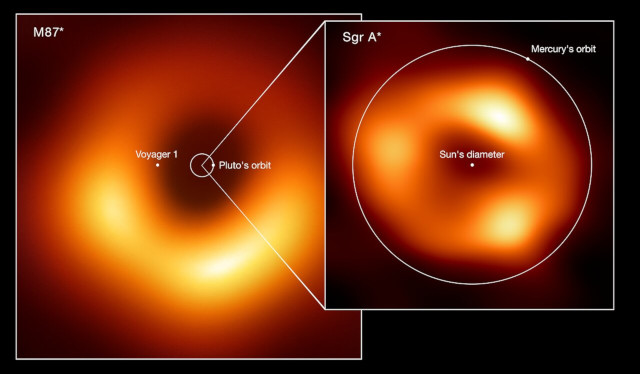
Sgr A* has a mass estimated at just over four million times the Sun’s but is small for a supermassive black hole. M87* is about a thousand times more massive, as indicated in the bottom image (EHT Collaboration (acknowledgment: Lia Medeiros, xkcd), where images of the areas around them are displayed side by side along with a diagram illustrating their relative size together with those of the Sun and Pluto’s orbit with the addition of the position of the Voyager 1 space probe to scale.
Mariafelicia De Laurentis, professor at the University of Naples Federico II, who is also part of the EHT Collaboration, explained that the fact that the structure of the magnetic field of M87* is so similar to that of Sgr A* is significant because it suggests that the physical processes that govern how a black hole powers and launches a jet could be universal among supermassive black holes, despite differences in mass, size, and surrounding environment.
The new result obtained by the Event Horizon Telescope offers the possibility of comparing black holes of very different sizes and masses. The data collected will be useful for improving theoretical models and therefore understanding the processes taking place near their event horizon.
The images of M87* revealed the presence of jets of materials ejected in the surrounding environment. They weren’t detected in Sgr A* but this doesn’t mean that they don’t exist. A new observation campaign will soon begin in which the EHT collaboration will include more radio telescopes and the detections will also take place at other frequencies.
There are plans to further improve the ALMA radio telescope, which is already the most powerful of those used in EHT campaigns. This means that in the coming years, it will be possible to take a further step forward in various astronomical studies, including those of the EHT investigating supermassive black holes and test models connected to the theory of relativity and others that seek to offer a new unified theory.