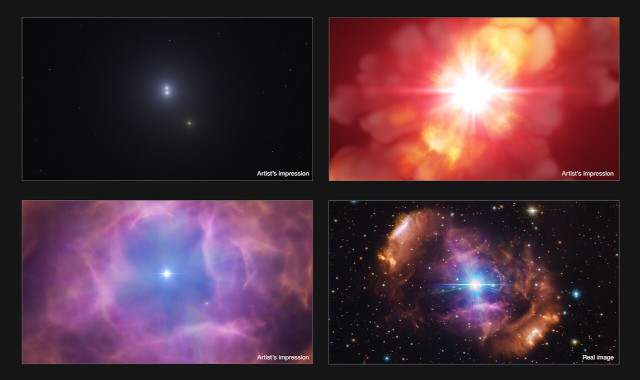
An article (link to the file in PDF format) published in the journal “Science” reports a study on the HD 148937 system, a binary system surrounded by a double nebula known as NGC 6164/6165. A team of researchers used the PIONIER and GRAVITY instruments mounted on ESO’s VLT Interferometer (VLTI) in Chile and archival data from the FEROS instrument at the La Silla Observatory, also an ESO’s telescope in Chile, to collect the data necessary to conclude that it was originally at least a triple system and at some point two of the stars merged. It was a violent event that created the cloud of materials around the system.
About 3,800 light-years from Earth, the HD 14893 system is now made up of two stars that appear to have different ages with one having a powerful magnetic field. The NGC 6164/6165 nebula around the stars, also known as the Dragon’s Egg, has an estimated age of around 7,500 years and is therefore very young compared to the stars.
Abigail Frost, an ESO astronomer and lead author of the paper, explained how she was struck by the features that made the HD 148937 system special given that a nebula surrounding two massive stars is rare. That stimulated research on this system with surprising results.
The data indicates that there are at least 1.5 million years of difference between the two stars and this doesn’t make sense because a pair of stars forms together. This made Abigail Frost and her colleagues think that something happened that rejuvenated one of the stars.
It took nine years of data from the PIONIER (Precision Integrated-Optics Near-infrared Imaging ExpeRiment) and GRAVITY instruments and others obtained from the archive of the FEROS (Fiber-fed Extended Range Optical Spectrograph) instrument to obtain a reconstruction of what probably occurred in the HD 148937 system.
Laurent Mahy, currently a senior researcher at the Royal Observatory of Belgium, one of the authors of this research, explained that he first thought of a stellar merger in 2017, after studying the nebula using observations conducted with ESA’s Herschel space telescope. Discovering the age discrepancy between the stars suggests that that scenario is the most plausible and it was possible to prove it with the new data obtained with ESO instruments.
In this scenario, the system HD 148937 was originally made up of three stars until the two inner ones violently merged, creating a magnetic star and ejecting materials that created the nebula. The more distant star formed a new orbit with the new companion.
The stellar merger must have occurred recently in astronomical terms because magnetism in massive stars doesn’t last long. That means that astronomers may have observed it shortly after the merger. Models already predicted that a merger would cause a new star to have a powerful magnetic field for a while, and the one in the HD 148937 system offers the most direct evidence yet.
The bottom image (ESO/L. Calçada, VPHAS+ team. Acknowledgment: CASU) shows an artistic representation of the phases of the stellar merger event in the HD 148937 system that generated the NGC 6164/6165 Dragon’s Egg nebula shown in the real astronomical image in the bottom right panel.
The story of the HD 148937 system is something of a cosmic puzzle that required examining data collected over nearly a decade to find evidence of what happened inside it. In Chile, ESO is building the Extremely Large Telescope (ELT), a new telescope that will aid this type of research by offering more details of the system. In this case, it could offer more information about magnetic stars and their evolution, and new instruments can also bring unexpected discoveries.