
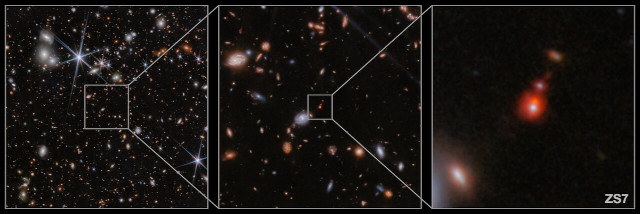
An article published in the journal “Monthly Notices of the Royal Astronomical Society” reports evidence of the ongoing merger of two supermassive black holes in a pair of galaxies cataloged as ZS7 in the early universe. A team of researchers used observations conducted with the James Webb Space Telescope to obtain images of this event which we see as it was taking place when the universe was about 740 million years old and was therefore very young in astronomical terms. This is the most distant pair of merging black holes discovered so far and could offer insights valuable to understand how these extreme objects grew so quickly.
The image (ESA/Webb, NASA, CSA, J. Dunlop, D. Magee, P. G. Pérez-González, H. Übler, R. Maiolino, et. al) shows the position of the ZS7 system in past observations conducted within the PRIMER (Public Release IMaging for Extragalactic Research) program with the James Webb space telescope’s NIRCam instrument which show progressive zooms going from left to right. The emissions from the ionized hydrogen in ZS7 are visible in the right panel in the orange region while emissions from the doubly ionized oxygen are visible in dark red.
The study of supermassive black holes has become very important in recent years, also thanks to the observations conducted with the most powerful instruments that entered service in recent decades. The possibility of observing these objects even when they are billions of light-years away made it possible to ascertain that they could have masses millions of times the Sun’s when the universe was still young. Astronomers are reconstructing the mechanisms that led to their quick growth, and the James Webb Space Telescope is providing a lot of new information. A new study on this topic was published earlier this month.
The GA-NIFS (Galaxy Assembly with NIRSpec Integral Field Spectroscopy) program uses in particular the NIRSpec (Near-InfraRed Spectrograph) instrument of the James Webb Space Telescope and made it possible to study the pair of galaxies cataloged as ZS7. The ongoing merger between two galaxies is a common event and when spotted in the early universe it offers the possibility of better understanding the early stages of galaxy evolution. This also means being able to catch two supermassive black holes as they move closer together until they merge.
In the case of the ZS7 system, the researchers estimated that one of the two supermassive black holes has a mass that is about 50 million times the Sun’s. The other is surrounded by large amounts of gas that make it difficult to obtain estimates of its characteristics. Its mass is probably similar to that of the other.
The researchers were accepted into a new observation program with the James Webb Space Telescope. This will allow this team to gain new insights into primordial galaxies and the influence supermassive black holes have on their evolution. In turn, galaxy mergers could also represent a significant mechanism for the growth of supermassive black holes. From this point of view, too, Webb could help achieve progress.
This study is based on observations of electromagnetic emissions but the authors talk about the possibilities of studying the ZS7 system to detect gravitational waves. This branch of astronomy has only existed for a few years and currently, it’s not possible to detect the type of gravitational waves emitted in the merger of supermassive black holes. However, ESA’s Laser Interferometer Space Antenna (LISA) mission, scheduled to launch during the next decade, aims to take this new type of study to the next level. That’s why in the coming years, we can expect innovations in the study of black holes and in the reconstruction of the first phases of the history of the universe.
