
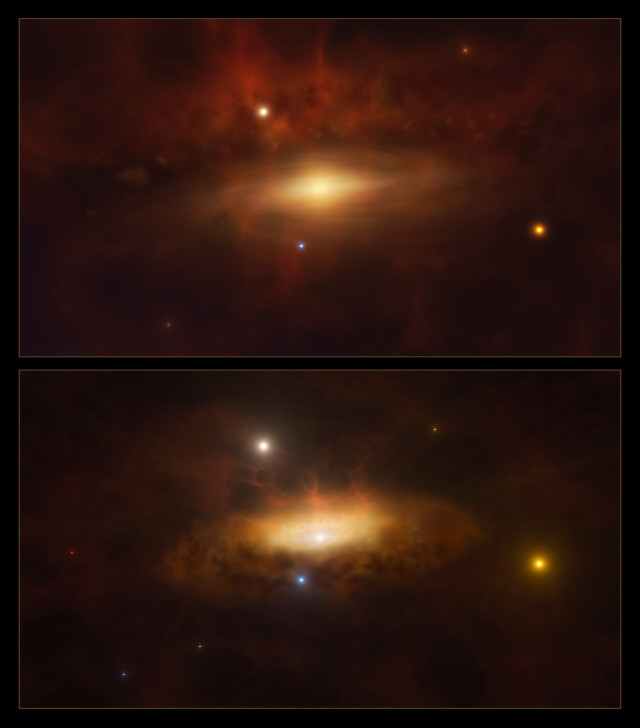
An article – link to the file in PDF format – accepted for publication in the journal “Astronomy & Astrophysics” reports the results of the observation of a new activity of the supermassive black hole at the center of the galaxy cataloged as SDSS J133519.91+072807.4 and called “simply” SDSS1335+0728. A team of researchers used observations conducted with various instruments to observe an increase in this galaxy’s brightness. This already led to its inclusion among those with an active galactic nucleus at the end of 2019.
The image (ESO/M. Kornmesser) shows an artist’s illustration of two phases of the formation of a disk of gas and dust around the supermassive black hole at the center of the galaxy SDSS1335+0728.
In February 2024, even X-rays coming from the galaxy SDSS1335+0728 were detected. Those are all behaviors that convinced the researchers that the supermassive black hole at its center started swallowing materials and heat others around it to the point that they are generating electromagnetic emissions that have become progressively more intense.
Astronomers now take it for granted that a galaxy has a supermassive black hole at its center. The activity of those extreme objects depends on the amount of materials that surround them but it can vary considerably over time. These are changes that can take a very long time but the starting moment and perhaps the final moment can be very quick from an astronomical point of view.
About 300 million light-years away from Earth, the galaxy SDSS1335+0728 showed no characteristics distinctive enough to deserve a proper name. That changed in late 2019, when its brightness suddenly increased dramatically. ESO astronomer Paula Sánchez Sáez stressed the fact that these sudden changes were unprecedented.
Phenomena such as supernovae and tidal disruption events can be bright but have a limited duration. In contrast, the brightness of the galaxy SDSS1335+0728 continued to increase. The authors of this study examined data collected by various instruments against new observations to obtain estimates of the changes. They found that since 2021 ultraviolet emissions have quadrupled compared to 2004, that since June 2022 the brightness has doubled in the mid-infrared, and in February 2024 X-ray emissions began.
Tidal disruption events in which a black hole destroys a star that comes too close to it are intense and therefore very bright but have a limited duration. For this to be an event of that type, it would have to be very slow for reasons currently incomprehensible. It’s not possible to rule it out completely nor is it possible to rule out an unknown phenomenon but the most likely explanation is that astronomers managed to capture the moment in which materials approached the supermassive black hole to the point of generating electromagnetic emissions.
Follow-up observations are needed to be certain that the nucleus of the galaxy SDSS1335+0728 has become active. Whatever process is underway, such an increase in brightness is interesting to astronomers and will continue to be monitored. ESO’s Very Large Telescope (VLT) in Chile is one of the telescopes used for this study, and its MUSE (Multi Unit Spectroscopic Explorer) instrument could provide further information.
