An article – link to the file in PDF format – accepted for publication in “The Astrophysical Journal” reports the first detection of aligned bipolar jets emitted by protostars in the Serpens Nebula. A team of researchers used observations conducted with the James Webb Space Telescope to obtain the details needed to spot these jets. Typically, they have different orientations within a star-forming region but in this case, they are aligned almost perfectly. This suggests that star formation may be at a unique time in its history in the Serpens Nebula and provide crucial information about these processes.
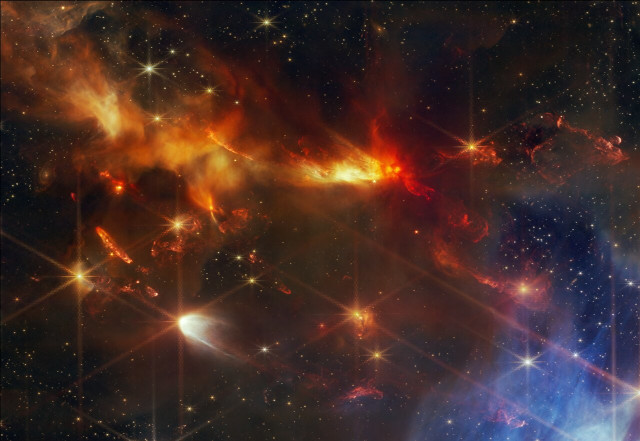
The top image (NASA, ESA, CSA, STScI, K. Pontoppidan (NASA’s Jet Propulsion Laboratory), J. Green (Space Telescope Science Institute)) shows the Serpens Nebula observed by the James Webb Space Telescope. In the upper left area, the protostars with their jets of materials are shown.
Astronomers are studying protostars and newborn stars to fully understand star formation processes. About 650 light-years away from Earth, the Serpens Nebula is in the cosmic neighborhood and has therefore been studied for a long time. However, so far, certain key details remained blurry and it took the James Webb Space Telescope to resolve jets of material emitted from the poles of protostars. The fact that they were aligned was a surprise but confirms the star formation models.
Stars form from clouds of interstellar gas following their gravitational collapse. At that point, the protostar’s spin increases as the gas compresses. A disk of materials forms around it and the magnetic fields inside it project some of the materials in jets perpendicular to the disk towards the poles of the protostar.
Some forces can shift the direction of the jets during the period of star formation. For example, when a binary system forms and the two protostars orbit each other affecting their orientation. This means that in a group of stars that are born together the orientations of the jets end up varying. In the Serpens Nebula, the orientation of the protostar jets was found to be almost perfectly parallel in images captured by the James Webb Space Telescope’s Near-InfraRed Camera (NIRCam).
According to the authors of this study, this suggests that the protostars in the Serpens Nebula are at a very similar stage in their evolution and that they inherited their spin from the same cloud filament in which they formed. These protostars could have formed from an isolated filament and, being very young, their jets still have their original alignment.
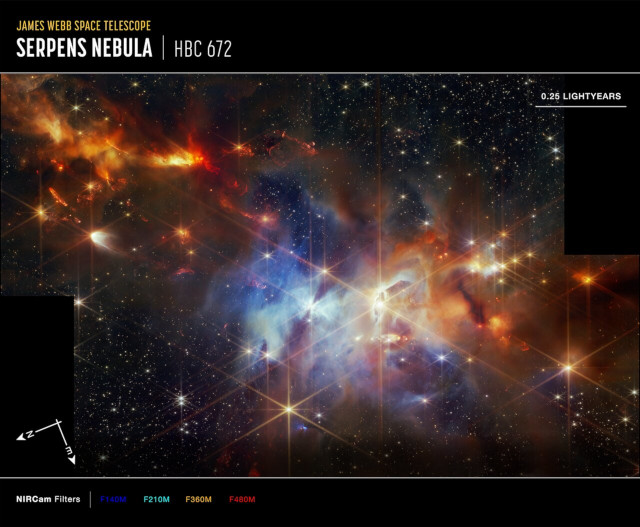
The bottom image (NASA, ESA, CSA, STScI, K. Pontoppidan (NASA’s Jet Propulsion Laboratory), J. Green (Space Telescope Science Institute)) shows a portion of the Serpens Nebula where it’s possible to see the aligned protostellar jets in red.
This study represents only the first phase of a larger scientific program. For this reason, the researchers will use another instrument of the James Webb Space Telescope, NIRSpec (Near-InfraRed Spectrograph), to study the chemical composition of the cloud hosting these protostars, in particular the volatile compounds, to understand how they survive the formation of stars and planets.