
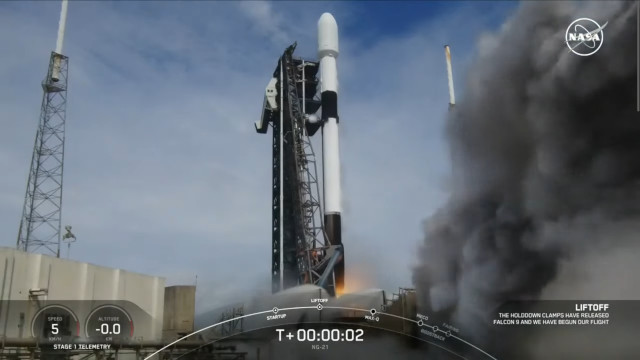
A little while ago, Northrop Grumman’s Cygnus spacecraft blasted off atop a SpaceX Falcon 9 rocket from the Kennedy Space Center on its NG-21 or CRS NG-21 mission. After about 15 minutes, it successfully separated from the rocket’s last stage and set on its course. This is the second of at least three resupply missions to the International Space Station with various payloads launched using the Falcon 9 rocket while waiting for the new version of Northrop Grumman’s Antares rocket to be ready.
The first launch of the new version of the Antares rocket is scheduled for June 2025 but in the meantime, Northrop Grumman must carry out other resupply missions to the International Space Station with its Cygnus space cargo ship. For this reason, the company purchased three launches to be carried out with SpaceX’s Falcon 9 rocket.
This Cygnus spacecraft was named S.S. Francis R. “Dick” Scobee (1939 – 1986) after the NASA astronaut who was among the victims of the Space Shuttle Challenger tragedy. This space cargo ship carries a total of about 3,850 kilograms (about 8,500 pounds) of cargo that includes 1,020 kilograms (about 2,250 pounds) of supplies of various types for the crew, 1,560 kilograms (a bit more than 3,400 pounds) of hardware and the rest in miscellaneous equipment and components.
On board the Cygnus is a repair kit for NICER (Neutron star Interior Composition Explorer), an X-ray telescope mounted outside of the Station to study in particular neutron stars but also gamma-ray bursts. Due to damage suffered in May 2023, it was no longer completely protected from sunlight. The solution so far was to use NICER when it was night on the Station but now 12 “patches” have been sent to cover the damaged parts and restore NICER’s full functionality.
Among the many biological experiments is ESA’s Rotifer-B2, which aims to investigate the effects of microgravity on the repair mechanisms of rotifers of the species Adineta vaga. These often microscopic animals are known for their ability to withstand very harsh conditions, including radiation doses 100 times higher than human cells can withstand.
The Cygnus spacecraft is scheduled to reach the International Space Station next Tuesday to be captured by the Canadarm2 robotic arm around 7 UTC. If there are no problems, the day after the arrival of the Cygnus, the crew will open the hatch and start the unloading operations.
