An article published in “The Astrophysical Journal” reports the discovery of the triple system cataloged as TIC 290061484, the most compact of its kind found so far. A team of researchers coordinated by NASA’s Goddard Space Flight Center used observations with NASA’s TESS space telescope, applied a machine learning technique, and involved citizen scientists who participated in the Planet Hunters project in a new project called the Visual Survey Group. This rare triple system will help astronomers better understand the processes of formation and evolution of multiple systems.
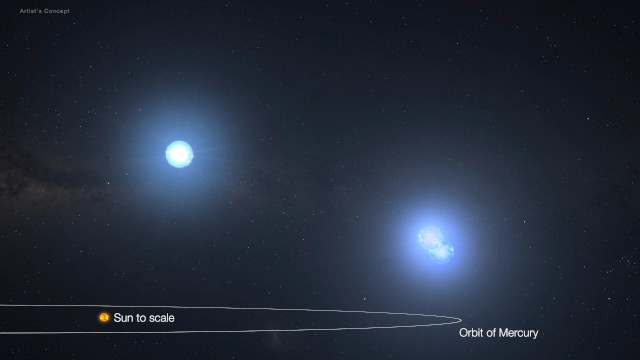
The image (NASA’s Goddard Space Flight Center) illustrates the TIC 290061484 system with its three stars showing its compactness with a scale representation of the orbit of the planet Mercury in the solar system.
Multiple systems are quite common, but compact hierarchical triples such as TIC 290061484 are rare, or at least rarely detected. It took a long time to discover the characteristics of the TIC 290061484 system, and Saul Rappaport, a professor emeritus at MIT and one of the authors of the paper, suggests that they may be more common than the available tallies suggest.
Triple systems can have very different orbital configurations, ranging from compact to long-period. Proxima Centauri orbits the Alpha Centauri pair over a very long period, so much so that evidence for that orbit has only emerged in recent years, with its duration calculated to be about 550,000 Earth years. In compact triple systems, the outer star has a much shorter orbital period. The term hierarchical is used because there’s an orbital hierarchy in which two stars orbit each other while the third one orbits the pair.
The authors of the discovery of the TIC 290061484 system applied a machine learning system to data collected by NASA’s TESS telescope integrated with observations conducted with other instruments. TESS is a planet hunter but its sensitivity in detecting the passage of an exoplanet in front of a star is also useful for detecting the eclipse caused by the passage of a star in front of one or more companions.
The data obtained from this first screening was submitted to a group of citizen scientists who had previously participated in the Planet Hunters project and subsequently participated in the Visual Survey Group project. The human eye can still ensure superior results to automatic systems for certain types of searches, and that of multiple systems is among them. In this case, the final result was the identification of TIC 290061484 as a triple system.
The set of data collected allowed to measure the characteristics of the TIC 290061484 system. The stars have masses that are 6.85, 6.11, and 7.90 the Sun’s. Two stars orbit each other in 1.8 days while the third orbits the pair in about 25 days. This makes it the most compact triple system known.
According to the researchers, the TIC 290061484 system is stable because the stars orbit practically on the same plane, so their gravitational force doesn’t generate disturbances on the orbits of their companions. No exoplanets were detected in the system but the formation of three stars would have destroyed the possible planets already during their formation phase. However, it’s possible that there are exoplanets that orbit the three stars but they should be very distant even from the outer star and therefore difficult to detect.
The two inner stars are so close together that they should merge after a period of expansion, triggering a supernova 20 to 40 million years in the future. The result should be the formation of a neutron star from the core left over from the star formed by that merger.
The discovery and subsequent examination of the TIC 290061484 system offers new insights into the formation and evolution of multiple star systems. That’s why astronomers are searching for systems like TIC 290061484 and hoping to find even more compact ones. This search is at the limits of current technology, and astronomers are awaiting the launch of NASA’s Nancy Grace Roman Space Telescope to monitor millions of stars and more easily detect multiple systems.
