Massimo Luciani

Uranus seen by Voyager 2 (Image NASA/JPL-Caltech)

An article published in the journal “Geophysical Research Letters” reports the discovery of a plasmoid, a structure composed of plasma formed mainly of hydrogen in the midst of magnetic fields, in the magnetotail – the magnetosphere’s tail – of the planet Uranus that was moving away from it. The plasmoid’s formation isn’t a new event because Gina DiBraccio and Daniel J. Gershman of NASA’s Goddard Space Flight Center examined the observations made by the Voyager 2 space probe during the its Uranus flyby on January 24, 1986. It’s the first plasmoid discovered in the Uranus’ atmosphere and could be a crucial mechanism for its loss of atmosphere.

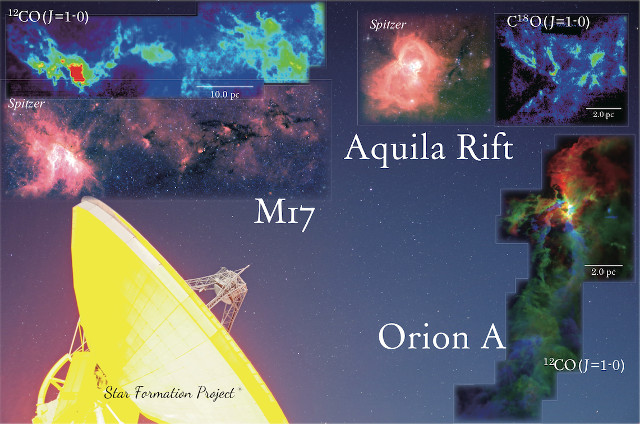
Star Formation Project montage

An article published in the journal “Publications of the Astronomical Society of Japan” reports the mapping of three interstellar clouds: Orion A, Aquila Rift, and M17. A team of researchers led by Professor Fumitaka Nakamura of the National Astronomical Observatory of Japan (NAOJ) used the Nobeyama radio telescope and for Orion A also data from the CARMA radio telescope array archive to achieve this result. This is an investigation not surprisingly called the Star Formation Project because the three interestellar clouds studied are nurseries for new stars.

Illustration of the quick growth mechanism for supermassive black holes

An article published in “The Astrophysical Journal” reports a study on a possible quick growth mechanism of supermassive black holes that could explain their presence when the universe was very young. Ph.D. student at SISSA (International School of Advanced Studies) Lumen Boco and his supervisor Andrea Lapi created a new model based on a process already considered important called dynamical friction in the gaseous medium applying it to multiple mergers.

Two examples of aligned and misaligned protoplanetary disks around binary stars

An article published in “The Astrophysical Journal” reports a study on the orbits of protoplanetary disks in binary systems, where different geometries were found. A team of astronomers led by Ian Czekala of the University of California at Berkeley used the ALMA radio telescope to study star systems in formation around two stars, which in jargon are called circumbinary disks. The conclusion is that the disks that orbit the more compact binary systems share almost the same plane while the disks that orbit the wider binary systems have significantly tilted orbital planes.

Illustration of photon subrings around a black hole

An article published in the journal “Science Advances” reports a study on the possibility of obtaining sharp images of the subrings that form the photon ring around a black hole. A team of researchers led by Michael Johnson of of the Center for Astrophysics – Harvard and Smithsonian (CfA) worked on the feat announced almost a year ago with the publication of the photo of the area around the supermassive black hole at the center of the galaxy M87. The researchers think that adding a space telescope to the ones used by the Event Horizon Telescope (EHT) collaboration would allow to obtain the sharpness needed to distinguish one of the subrings, whose characteristics would allow to obtain more precise measurements of the mass of the black hole and more.