Massimo Luciani

Artist's concept of a Voyager space probe (Image NASA/JPL-Caltech)

Five articles published in the journal “Nature Astronomy” report various detections carried out by NASA’s Voyager 2 space probe in interstellar space. A number of teams of researchers examined the data collected by the five instruments still in use with each article dedicated to the data from a single instrument. Taken together, they help to understand interstellar space outside the heliosphere, the bubble in which the influence of the Sun is felt. One year after coming out of that bubble, Voyager 2 sent a lot of data on plasma and cosmic rays showing the differences compared to those within the heliosphere.

The Cygnus Alan Bean cargo spacecraft captured by Canadarm2 robotic arm (Image NASA TV)

Northrop Grumman’s Cygnus spacecraft, launched last Saturday, November 2, has just reached the International Space Station and was captured by the Canadarm2 robotic arm. Astronaut Jessica Meir, assisted by her colleague Christina Koch, will soon begin the slow maneuver to move the Cygnus until it docks with the Station’s Unity module after about two hours.

Northrop Grumman's Cygnus cargo spacecraft blasting off atop an Antares rocket (Image NASA TV)

A little while ago Northrop Grumman’s Cygnus spacecraft blasted off atop an Antares rocket from the Mid-Atlantic Regional Spaceport (MARS), part of NASA’s Wallops Flight Facility (WFF) on Wallops Island. After about nine minutes it successfully separated from the rocket’s last stage went en route to its destination. This is its 12th official mission, called NG-12 or CRS NG-12, to transport supplies to the International Space Station for NASA.

A possible low-mass black hole discovered

An article published in the journal “Science” reports the discovery of what could be the lowest-mass known black hole, perhaps even the first of a new class of black holes. A team of researchers led by Professor Todd Thompson of Ohio State University used data from APOGEE (Apache Point Observatory Galactic Evolution Experiment) to discover a binary system that includes an invisible object that could be a black hole. If instead it were a neutron star it would be by far the most massive known, far beyond the theoretical highest limit before the collapse of such an object into a black hole.

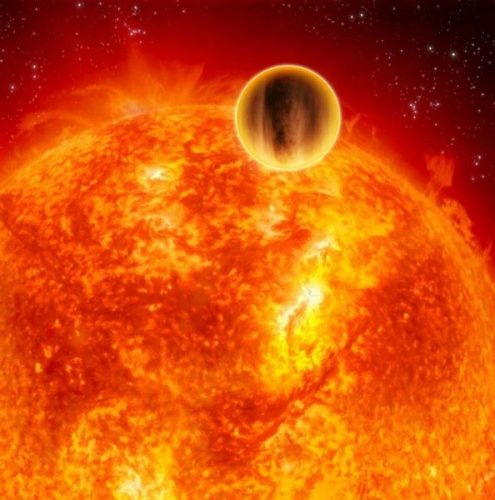
Artist's concept of exoplanet near its star (Image ESA)

An article published in “The Astrophysical Journal” reports the study of exoplanets that orbit two red giant stars: HD 212771 and HD 203949. A team of researchers led by Tiago Campante of the Instituto de Astrofísica and Ciências do Espaço (IA) of the University of Lisbon, Portugal, applied the astrosismology technique to observations conducted with NASA’s TESS space telescope. The result was surprising in the case of the HD 203949 system because the planet wasn’t swallowed by the star during its expansion even though it orbited very close to it.