Massimo Luciani

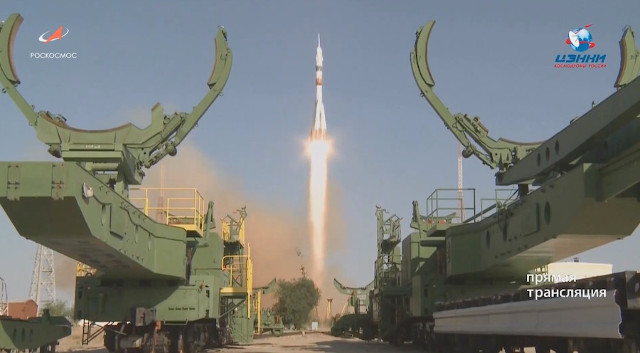
The Soyuz MS-14 spacecraft during its docking attempt (Image NASA)

A few hours ago the Soyuz MS-14 spacecraft, which blasted off about two days ago from the Baikonur Cosmodrome in Kazakhstan, attempted to dock with the International Space Station but a communications problem forced to abort the maneuver. Cosmonauts Alexey Ovchinin and Alexander Skvortsov are working together with the Russian space agency Roscosmos to retry the docking on Monday while the Soyuz MS-14 remains at a safe distance.

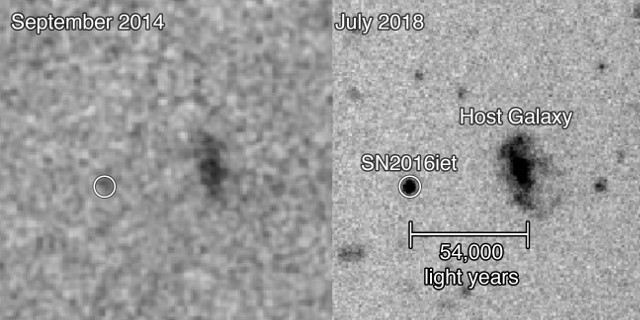
SN 2016iet is probably a pair-instability supernova

An article published in “The Astrophysical Journal” reports a study on the supernova SN 2016iet. A team of researchers used a number of telescopes to collect data on it. Almost three years of study have followed its first sighting, which happened on November 14, 2016, leading to estimate that the progenitor star had a mass about 200 times the Sun’s which exploded in what appears to be the first strong case of pair-instability supernova, which ends with the star’s total destruction.

The Moon shines in gamma rays

An analysis of the Moon’s gamma-ray brightness performed by Mario Nicola Mazziotta and Francesco Loparco of the National Institute of Nuclear Physics, Bari, Italy, using NASA’s Fermi Gamma-ray Space Telescope’s Large Area Telescope (LAT) instrument revealed that at certain electromagnetic wavelengths the Moon is brighter than the Sun. It’s the result of the interaction of the Moon with cosmic rays so the observations of those gamma rays offer new information on very energetic cosmic events but also on the Moon’s environment. Studying that environment has become more important following the new projects of manned Moon missions.

An article submitted for publication in the “Astrophysical Journal Letters” reports the discovery of eight repeating Fast Radio Bursts (FRBs). The CHIME/FRB collaboration, the team of scientists who use the CHIME radio telescope to search for these phenomena, gathered evidence of these new Fast Radio Bursts after the announcement of the second repeating one’s discovery months ago. This suggests that these phenomena are not so rare compared to non-repeating ones but that we have only recently found a way to detect them.