Massimo Luciani

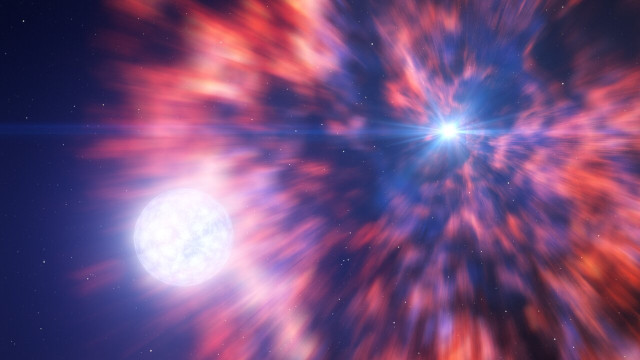
Artist's concept of the aftermath of a supernova in a binary system (Image ESO/L. Calçada)

Two articles, one published in the journal “Nature” and one in “The Astrophysical Journal Letters”, report different aspects of a study of the supernova remnant cataloged as SN 2022jli which include evidence of the presence of a compact object that could be a neutron star or a black hole that formed after the supernova. Two teams of researchers used various instruments including the Very Large Telescope (VLT) and the New Technology Telescope (NTT), both ESO’s, to study the consequences of this supernova and find the direct link to the formation of a compact object.

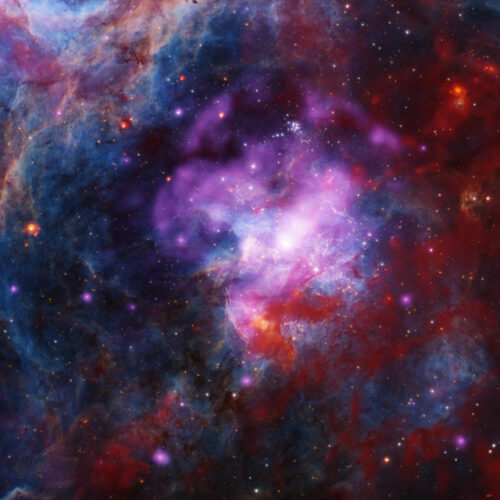
30 Doradus B (Image X-ray: NASA/CXC/Penn State Univ./L. Townsley et al.; Optical: NASA/STScI/HST; Infrared: NASA/JPL/CalTech/SST; Image Processing: NASA/CXC/SAO/J. Schmidt, N. Wolk, K. Arcand)

An article published in “The Astronomical Journal” reports evidence that the supernova remnant cataloged as 30 Doradus B, or simply 30 Dor B, is the result of at least two separate supernovae and not just one. A team of researchers led by Wei-An Chen of the National Taiwan University combined observations conducted with various telescopes in different electromagnetic bands to find evidence of a vast but very faint shell spanning 130 light-years that adds to the remnant visible at optical frequencies. At the same time, a wind was detected that generates a nebula of the type called pulsar wind nebula. That remnant can’t have been generated by a single supernova.

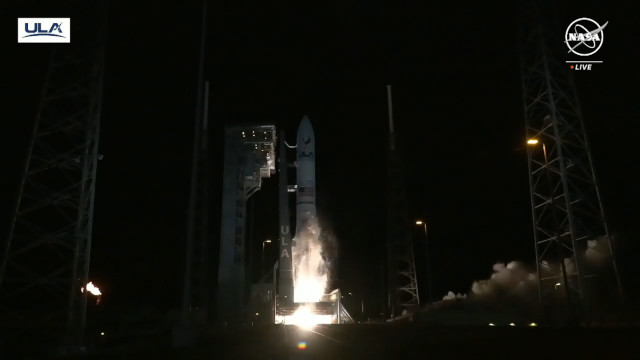
The Vulcan rocket blasting off (Image NASA TV)

A little while ago, ULA’s Vulcan rocket launched on its maiden mission, formally designated as CERT-1. For the occasion, it was carrying Astrobotic Technology’s Peregrine Moon lander, which separated from the rocket stage called Centaur after about 50 minutes. A capsule containing ashes of various famous people was also launched into a heliocentric orbit. The Centaur continued its mission with a few burns and cut-offs of its engine until it goes out of Earth orbit, scheduled after just under 4.5 hours from the launch.

Artist's concept of potentially habitable exoplanets (Image courtesy Christine Daniloff, MIT; iStock)

An article published in the journal “Nature Astronomy” reports a study that examines the possibility of using the measurement of carbon scarcity in the atmosphere of a temperate rocky planet as an indicator of the presence of oceans of liquid water and possible life forms. A team of researchers led by Julien de Wit of MIT and Amaury Triaud of the British University of Birmingham devised a strategy based on the James Webb Space Telescope’s detection capabilities and includes an additional step consisting of the detection of ozone.

The Dragon cargo spacecraft departing the International Space Station to end its CRS-29 mission (Image NASA TV)

A few hours ago, SpaceX’s Dragon spacecraft ended its CRS-29 (Cargo Resupply Service 29) mission for NASA splashing down smoothly off the Florida Coast. The Dragon left the International Space Station a little more than 19 hours earlier. For SpaceX, this was the 9th mission of the 2nd contract with NASA to transport supplies to the Station with the new version of the Dragon cargo spacecraft.

Shortly after the splashdown, SpaceX’s recovery ship went to retrieve the Dragon to transport it to the coast. The cargo brought back to Earth will be delivered to NASA within a few hours. The Dragon spacecraft reached the International Space Station on November 11, 2023.