Massimo Luciani

The AzTECC71 galaxy (Image J. McKinney/M. Franco/C. Casey/The University of Texas at Austin)

An article published in “The Astrophysical Journal” reports a study on AzTECC71, what appears to be a dusty primordial galaxy in which remarkable star formation is taking place. A team of researchers from the COSMOS-Web collaboration led by Jed McKinney of the University of Texas at Austin observed what appeared to be a ghost galaxy with the James Webb Space Telescope. The peculiarity of this study is that AzTECC71 was detected by some ground-based telescopes but didn’t appear to the Hubble Space Telescope. This may be a much more common case than previously thought that requires some sort of ghostbuster to find.

The Progress MS-25 cargo spacecraft approaching the International Space Station (Image NASA TV)

A little while ago, the Progress MS-25 spacecraft docked with the International Space Station in the mission also referred to as Progress 85 or 85P. The Russian cargo spacecraft, which blasted off last Friday, December 1, carries food, water, scientific experiments, fuel, and various hardware. The Progress spacecraft have an automatic docking system but in case of problems, the cosmonauts on board the Station take control of it and that’s what happened today to complete the maneuver.

The Progress MS-25 cargo spacecraft blasting off atop a Soyuz-2.1a rocket (Image NASA TV)

A little while ago, the Progress MS-25 spacecraft blasted off atop a Soyuz-2.1a rocket from the Baikonur Cosmodrome in Kazakhstan. After about nine minutes it successfully separated from the rocket’s last stage and was placed on its route. The cargo spacecraft began its resupply mission to the International Space Station also called Progress 85 or 85P. In this mission, the route used is the one that requires about two days.

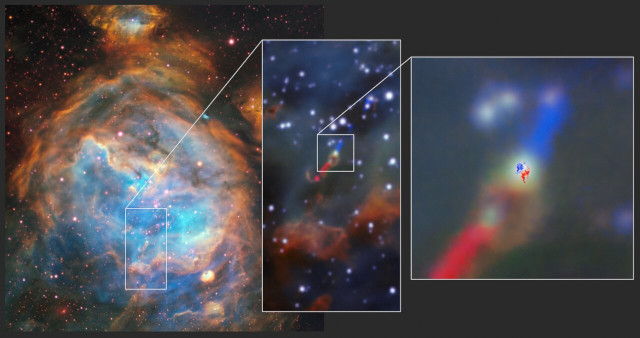
The HH 1177 system

An article published in the journal “Nature” reports the identification of a protoplanetary disk around the very young star cataloged as HH 1177 in the Large Magellanic Cloud, one of the dwarf galaxies satellite of the Milky Way. A team of researchers used the ALMA radio telescope to observe the disk in a follow-up study after observations conducted with the MUSE instrument mounted on the VLT allowed to see jets coming from the still-forming star. This is the first detection of a circumstellar disk in another galaxy. That type of structure is also called a Keplerian disk in jargon because it obeys the same laws as planetary motion.

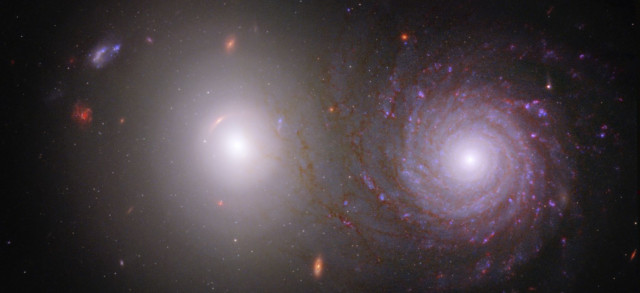
An elliptical galaxy on the left and a spiral galaxy on the right

An article published in the journal “Nature Astronomy” provides an explanation for the scarcity of spiral galaxies in the so-called Supergalactic Plane. A team of researchers used results obtained from the SIBELIUS supercomputer simulation to offer an explanation based on galaxy mergers. The analysis of the results indicates that in galaxy clusters present on the Supergalactic Plane, interactions and mergers are common with the result that spiral galaxies merge to become elliptical galaxies. Far from the Supergalactic Plane, galaxies are more isolated and therefore less likely to merge.