Massimo Luciani

The Shenzhou 14 capsule after landing (Photo courtesy Xinhua/Li Gang)

A little while ago, the three Chinese taikonauts of the Shenzhou 14 mission returned to Earth after spending almost six months on the Chinese space station Tiangong. The three taikonauts Cai Xuzhe, Chen Dong, and Liu Yang departed the station a few hours earlier to land at a site called Dongfeng in China’s Inner Mongolia Autonomous Region. A procedure that significantly reduces the time to return to Earth worked perfectly again.

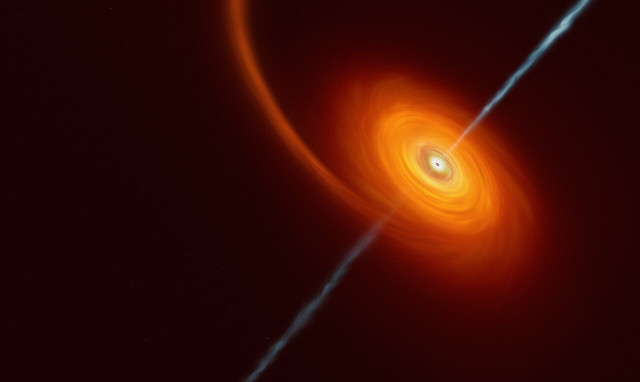
Artist's representation of the AT2022cmc event (Image ESO/M.Kornmesser)

Two articles, one published in the journal “Nature” and one in the journal “Nature Astronomy”, report different aspects of the study of the most distant supermassive black hole discovered as it devours a star and then emits a jet of materials accelerated at speeds close to the speed of light. The event, cataloged as AT2022cmc, is somewhat similar to a gamma-ray burst but was detected in various electromagnetic bands thanks to the fact that it’s aimed almost exactly at Earth. This is the first event of its kind detected in visible light, so it can offer new insights into the behavior of truly extreme objects during the destruction of a star that got too close to them.

The Shenzhou 15 mission blasting off (Photo courtesy (Xinhua/Li Gang)

A confirmation has arrived that three Chinese taikonauts from the Shenzhou 15 mission reached the Chinese space station Tiangong with an automated docking maneuver. They blasted off about seven hours earlier on a Long March-2F rocket from the Jiuquan Satellite Launch Center. They form the fourth crew of the Chinese space station and will remain there for about six months, the standard duration for a mission.

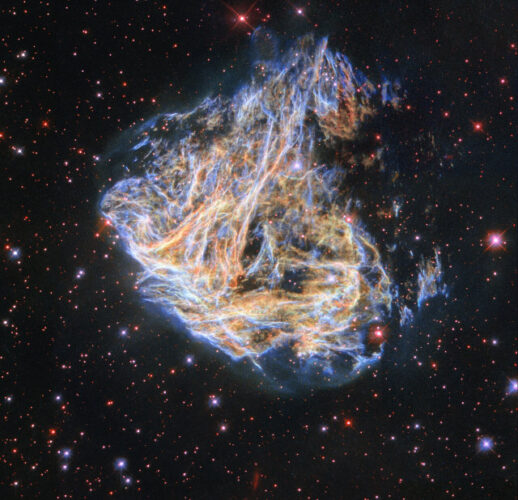
The supernova remnants DEM L 190 (Image ESA/Hubble & NASA, S. Kulkarni, Y. Chu)

An image captured by the Hubble Space Telescope portrays the supernova remnants cataloged as DEM L 190 or LMC N49 or by other designations observed in the Large Magellanic Cloud. The debris produced by the explosion of a massive star formed what appear from Earth as delicate colored filaments. Those materials projected into interstellar space could end up in other stellar systems, perhaps even in protoplanetary disks which will be enriched by the elements generated by the progenitor star and by the supernova.

The Dragon 2 cargo spacecraft approaching the International Space Station in its CRS-26 mission (Image NASA TV)

A little while ago, SpaceX’s Dragon 2 spacecraft docked with the International Space Station’s Harmony module completing the first leg of its mission. It blasted off on a Falcon 9 rocket from the Kennedy Space Center in its CRS-26 (Cargo Resupply Service 26) mission, also referred to as SpX-2, on Saturday, when it was the afternoon in the USA. Astronauts Josh Cassada and Nicole Mann monitored the operation but the cargo spacecraft completed the maneuvers in an automated way without any problems.